
Task Details
The Task Details page shows one task: its description, status, assignment, linked items, history and comments.
Click a task ID in the Task List, or click View Task on a defect.
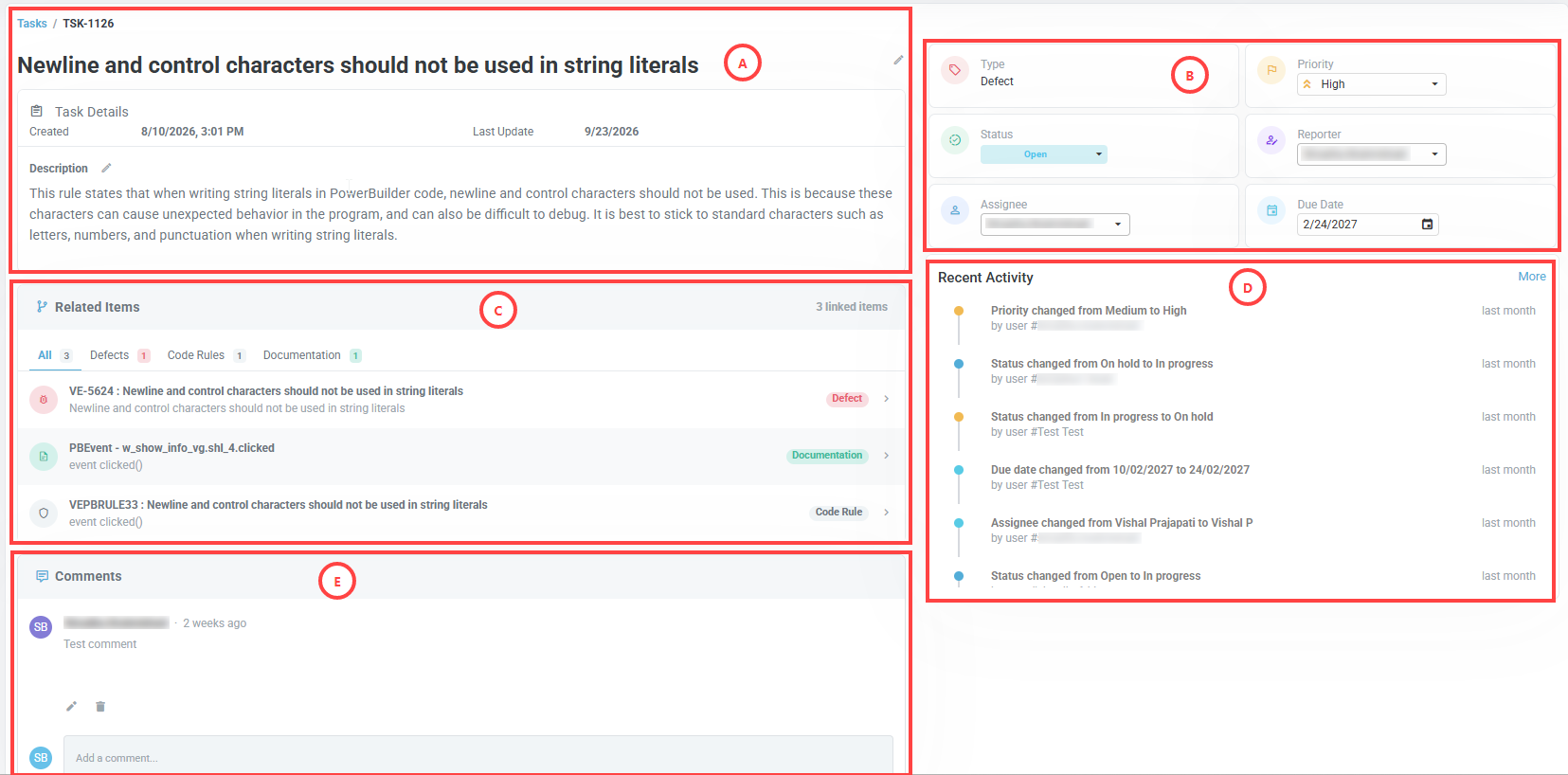
Task information (A)
- Task Title – A short descriptive summary of the work, at the top of the page. It can be edited with the pencil beside it.
- Task ID – The task identifier, such as TSK-1126, shown in the breadcrumb.
- Created – The date and time the task was created.
- Last Update – The most recent date the task was modified.
- Description – What has to be done. Prefilled from the rule description when the task is created, and editable afterwards.
Status and assignment (B)
The panel on the right carries the fields that move during the life of the task.
- Type – Indicates the type of task. In the example, the task type is Defect, indicating that the task represents an issue that needs to be addressed. The type cannot be changed, either when the task is created or afterwards.
- Status – Open, In Progress, On Hold, Completed or Cancelled.
- Priority – Urgent, High, Medium, Low or Lowest. Prefilled from the rule when the task is created, and adjustable at any time.
- Reporter – The user who created the task.
- Assignee – The team member responsible for the work.
- Due Date – The date by which the task is expected to be completed. Prefilled seven days after the assignment, and adjustable.
Related Items (C)
A task is linked to the defect it was created from, and to everything that explains it. The All, Defects, Code Rules and Documentation tabs filter the entries, each with its count. Click an entry to open it.
- Defect – The defect the task was created from.
- Code Rule – The rule that produced the defect, with what it requires and why.
- Documentation – The documentation page of the object concerned – a window, an event, a procedure.
Recent Activity (D)
The history of the task – priority, status, due date and assignee changes – each with its author and how long ago it happened. More opens the full history.
Comments (E)
Comments on the task, each with its author and when it was written. Use the pencil and bin icons to edit or delete a comment, and the Add a comment… field to add one.
The task form
The same eight fields appear when a task is created from a defect and when it is updated.
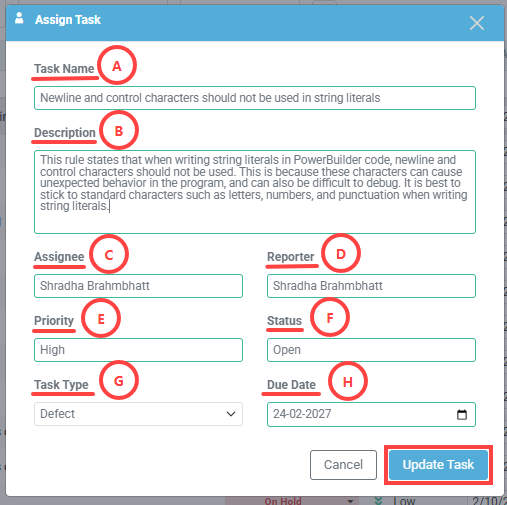
- A - Task Name – Prefilled with the defect identifier and the rule title, for example VE-1: Conditionals should start on new lines.
- B - Description – Prefilled from the rule description. Can be replaced with instructions for the assignee.
- C - Assignee – The team member responsible for addressing the defect.
- D - Reporter – The user creating the task, prefilled with the current user.
- E - Priority – Prefilled from the rule, and adjustable.
- F - Status – Open by default.
- G - Task Type – Defect. Only defect-related tasks exist at present. The type cannot be changed.
- H - Due Date – The date by which the defect should be addressed. Prefilled seven days after the assignment.
Related procedures
- Assign a defect to a developer - Triaging defects
- Start work on a task - Fixing defects
- Close the task - Fixing defects
- Reschedule a task - Following remediation progress
- Cancel or delete a task - Following remediation progress