
Defect Details
The defect view brings together everything needed to understand and resolve a single defect: its status and ownership, the occurrences found, the affected source code, the rule that triggered it, and the history of what has been done to it.
Click a defect in the list to open its details in the right-hand panel.
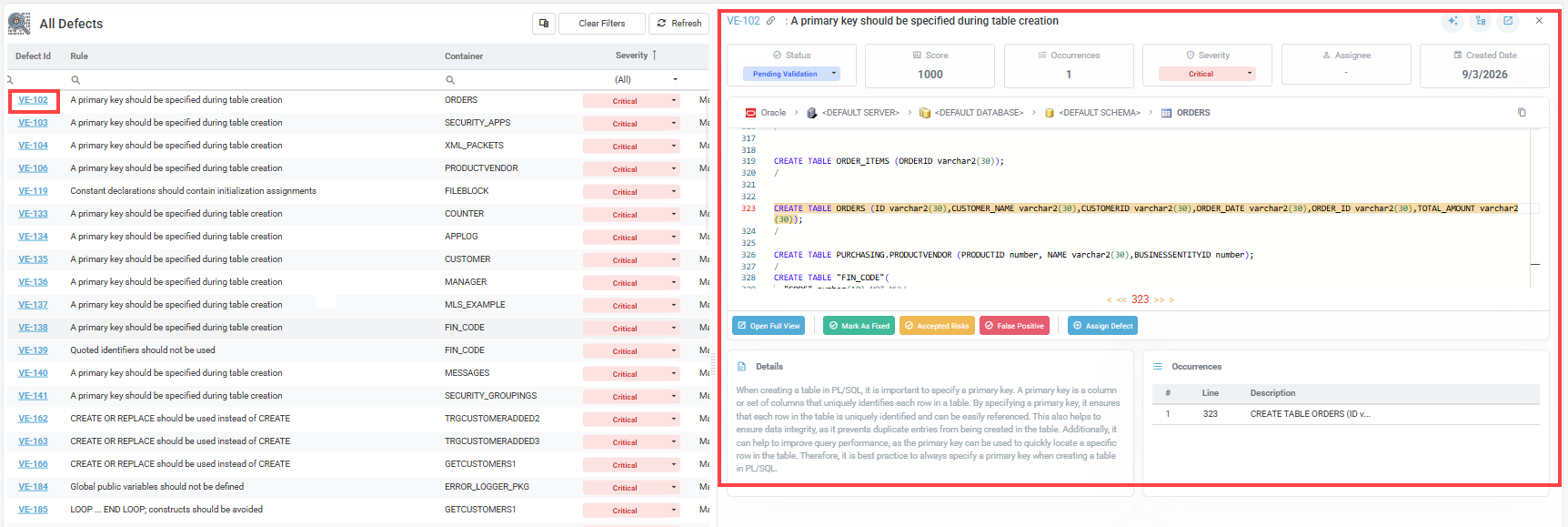
Click Open Full View to show the same defect on its own page, with more room for the source code and two additions: the Recent Activity of the defect, and the Benefits tab of the rule description.
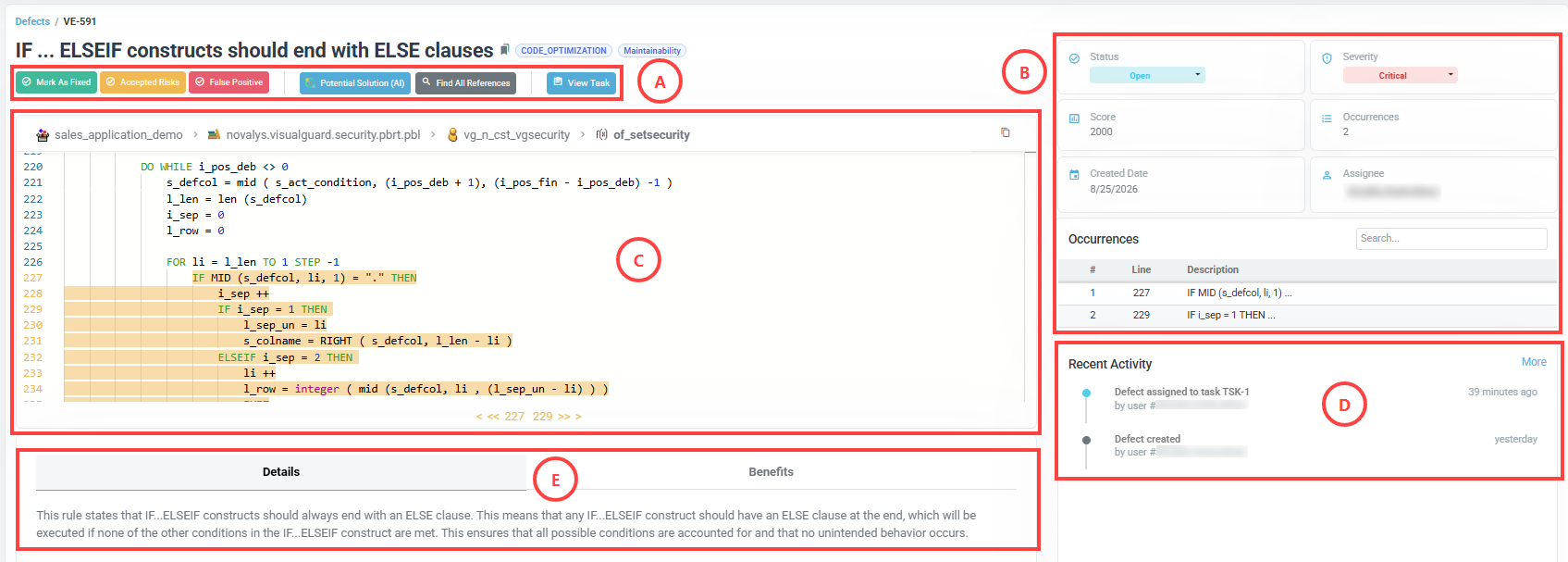
A - Actions
- Mark As Fixed – Declares the defect corrected once the code changes have been made. The defect moves to Pending Validation.
- Accepted Risks – Records the defect as an accepted risk: the team has reviewed it and decided that no remediation is required.
- False Positive – Records the defect as not being a real problem, or as not applicable to this application.
- Potential Solution (AI) – Analyses the defect and proposes a remediation approach, which the developer can use as guidance when modifying the code.
- Find All References – Lists the references to the affected object in the application, to assess dependencies before making a change.
- Assign Defect – Creates a task and assigns the defect to a team member. Once a task exists, this button is replaced by View Task.
- View Task – Opens the task created from this defect.
B - Status, key fields and occurrences
- Status – The current lifecycle stage, shown as a dropdown: it can be changed from here as well as from the list.
- Severity – The severity of the defect, also a dropdown.
- Score – The impact score of the defect, calculated from its severity and its number of occurrences. See Defect List.
- Occurrences – How many times the rule is broken in this container. The Occurrences table lists each one with its line number. Click an occurrence to move the source code viewer to that line.
- Created Date – The date on which the defect was created, which indicates its age.
- Assignee – The team member responsible for the defect. The field is filled when a task is created.
C - Source code viewer
The source code shown with the offending lines highlighted, so that the developer can read the problem in its context. A breadcrumb above the code gives the full path of the container, from the application down to the object.
When a defect holds several occurrences, a navigation bar under the code lists their line numbers and moves the viewer between them: first, previous, a given line, next, last.
D - Recent Activity
The chronological history of the defect - creation, assignment to a task, status changes - each with its author and how long ago it happened. The More option opens the full history.
This section appears in the full view only.
E - Rule description
Why the rule exists and what it asks for, under two tabs.
- Details – Why the defect was detected, its potential impact, and the recommended corrective actions.
- Benefits – How the suggested changes improve the code.
Related procedures
- Examine the defect - Fixing defects
- Measure the impact of a correction before making it - Fixing defects
- Get a suggested correction - Fixing defects
- Mark the defect as fixed - Fixing defects
- Change the severity of a defect - Triaging defects
- Record a false positive, an accepted risk, or put a defect on hold - Triaging defects