
AI & Code Maintenance:
The 2025 guide to co-intelligence for developers, architects, and Ops

This white paper provides a realistic assessment of AI in 2025 for development teams: its actual capabilities, its limitations, and how to leverage it effectively for analyzing, documenting, and maintaining complex codebases.
Written for developers, architects, and Ops professionals, this document focuses on practical use cases, technical constraints, and best practices for integrating AI into your existing code tools and workflows.
1. Executive Summary
AI has now reached sufficient maturity to assist developers with certain complex tasks: code generation, review, impact analysis, documentation, and debugging support. However, it remains far from autonomous intelligence and continues to make mistakes—sometimes with complete confidence.
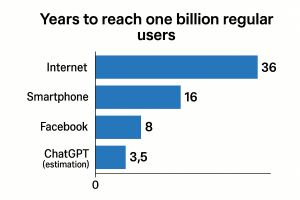
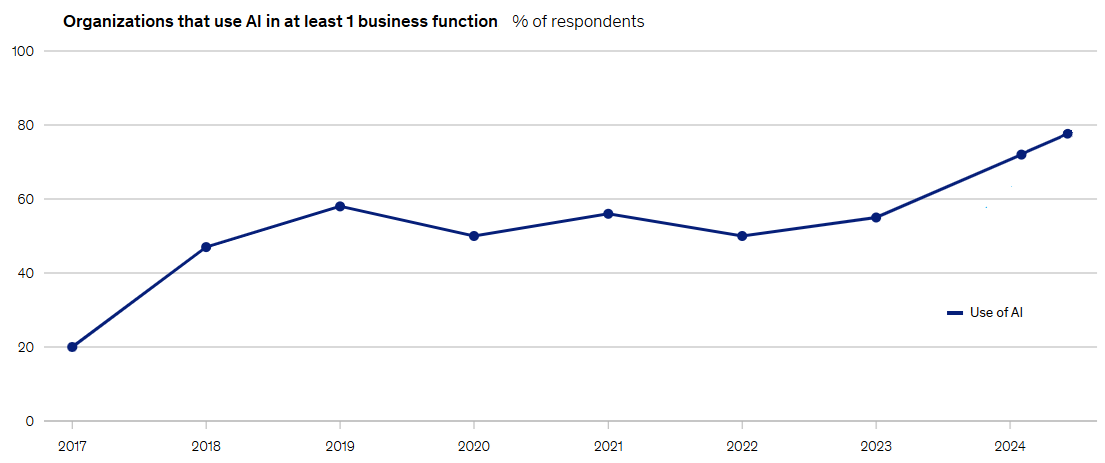
Meanwhile, adoption is accelerating: roughly one billion people now use AI regularly, with a growing share for professional purposes. While 78% of companies report using AI, only 1% believe they are fully leveraging its potential.
This white paper examines the current state of AI for development tools, its strengths and limitations, security and compliance considerations, and demonstrates how to integrate it into code analysis and maintenance workflows. It draws on our experience with Visual Expert, which combines deep static analysis with reasoning AI to explain, document, and improve complex code.
Our key assumptions:
- AI will not replace developers or architects in the short to medium term;
- However, it will quickly become indispensable for staying competitive—provided it is used within a controlled framework, with appropriate governance and consistent human oversight.
2. Context: Why AI is becoming essential for development teams
Development teams continue to face mounting pressure:
- Delivering faster, with shorter release cycles;
- Maintaining legacy applications that are increasingly large and business-critical;
- Integrating new technologies (cloud, microservices, APIs, security, and AI itself);
- Meeting ever-stricter compliance and cybersecurity requirements.
In this context, AI offers a potential lever for boosting productivity.
However, simply using a general-purpose chatbot is not enough. Without structured context and a holistic understanding of the system, AI operates partially blind: it may produce plausible but incorrect answers, overlook actual dependencies, or ignore critical constraints.
The real challenge is not just to use AI, but to identify the tasks where it can genuinely add value, and to integrate it with development tools that can provide rich, structured context.
3. The state of AI in 2025
3.1. ANI, AGI, ASI: What we actually have today
The literature identifies three theoretical stages of AI evolution:
ANI – Artificial Narrow Intelligence
This is today's AI: chatbots, image recognition, diagnostic assistance, code assistants. It excels at specific tasks but lacks broader understanding. It performs well within defined boundaries but struggles outside them.
AGI – Artificial General Intelligence
An AI capable of learning and adapting to new contexts with human-like flexibility: abstract reasoning, creativity, and world understanding. No current model approaches this level, and most experts doubt we will reach it in the medium term.
ASI – Artificial Super Intelligence
An AI that would surpass humans across all domains—science, strategy, intuition—and could improve its own models. This remains firmly in the realm of science fiction. No industry player claims to be working toward it.
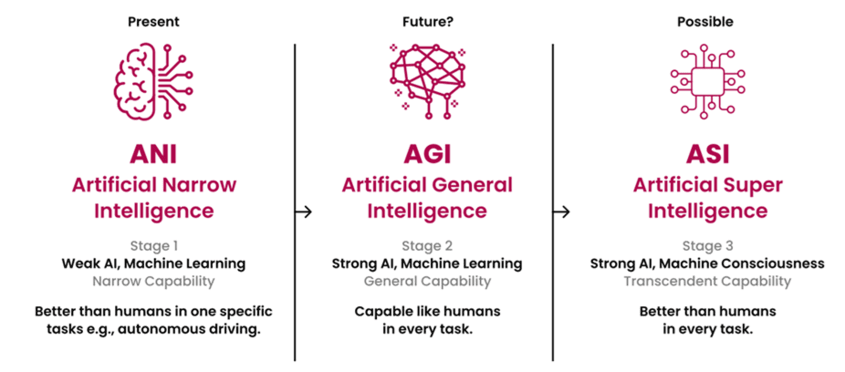
For practical purposes, we will remain in the ANI domain for years to come, with powerful but specialized models that depend heavily on their training data and context.
3.2. From conversation to agents: conversational, generative, reasoning, and agentic AI
Since 2022, ANI models have evolved through several stages:
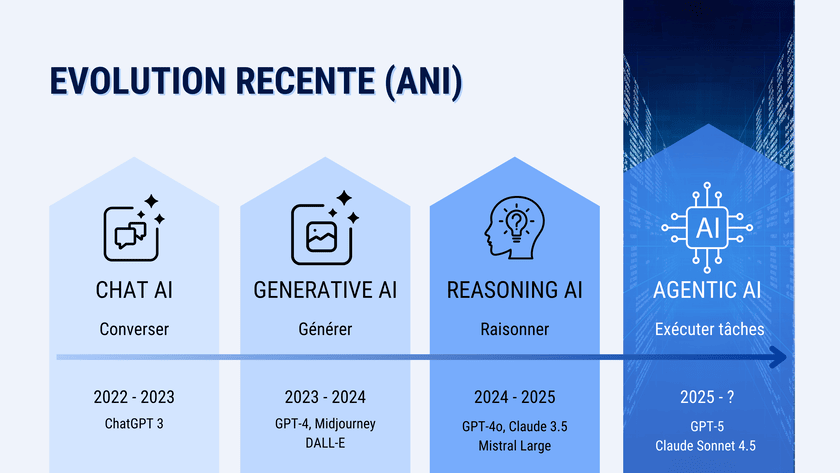
2022–2023 - Conversational AI
- Natural language comprehension.
- Question answering, text explanation, and reformulation.
- Limitations: static responses, limited memory, frequent errors.
2023–2024 - Generative AI
- Creation of text, images, code, music, and video (GPT-4, DALL-E, etc.).
- Ability to follow a given style, tone, or structure.
- Limitations: shallow semantic understanding, limited reasoning.
2024–2025 - Reasoning AI
- Capable of chaining reasoning steps, partial self-correction, and tool use (search, calculation, etc.).
- Highly relevant for dev tools: problem-solving, debugging, code explanations, structured reviews.
- Limitations: often sound 'local' logic, but weak big-picture view; still not autonomous, still error-prone.
2025 onward - Agentic AI
- AI that plans and executes a sequence of tasks toward a goal.
- Combines reasoning with actions (browsing, calling APIs, etc.).
- Limitations: still relies on human guidance, still makes mistakes.
At Visual Expert, we use Reasoning AI embedded in a structured procedural framework, rather than delegating initiative to agents we currently consider immature.
The AI is used to explain, document, analyze, and improve code—based on precise context that Visual Expert provides after static code analysis, triggered by the developer at the right moment.
4. AI capabilities and limitations for development tasks
4.1. Raw performance: IQ tests and benchmarks
Recent benchmarks show that some models achieve human-level performance on standardized IQ tests. On paper, AI appears 'comparable' to humans in certain areas...
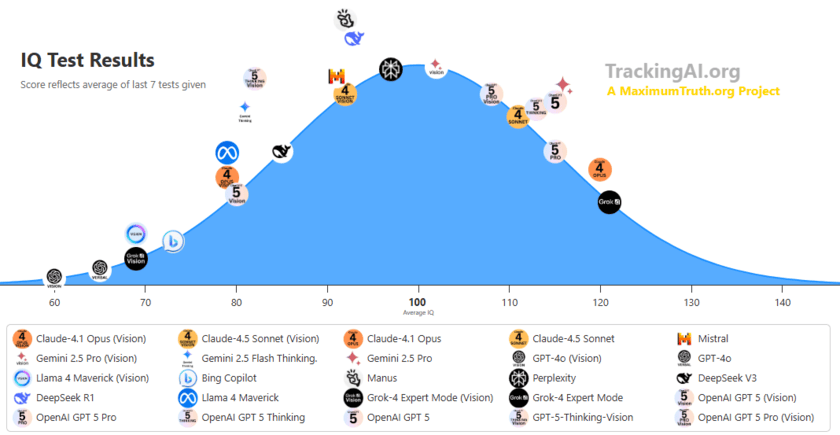
– The top models crossed the symbolic 100 threshold in 2025
...but these scores primarily measure raw capability on well-defined tasks (formal problem-solving, logic, text comprehension). They do not reflect robustness, adaptability, or the ability to manage a complex, evolving system like an enterprise codebase.
4.2. Adaptability tests: Where AI still falls short
To better assess AI limitations, organizations like the ARCPrize Foundation have developed tests that measure adaptability to novel tasks with implicit rules and shifting context.
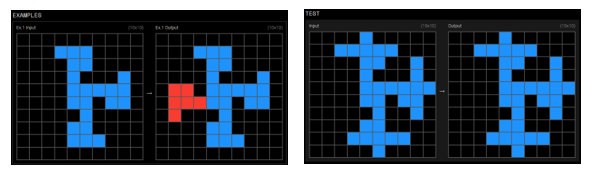
Key findings:
- Most models struggle to exceed a 60% success rate on puzzles that humans solve with ease;
- On tests combining adaptability and efficiency, most models score below 10%, with top performers barely reaching 20%.
- These scores are improving far more slowly than the raw performance measured by traditional benchmarks.
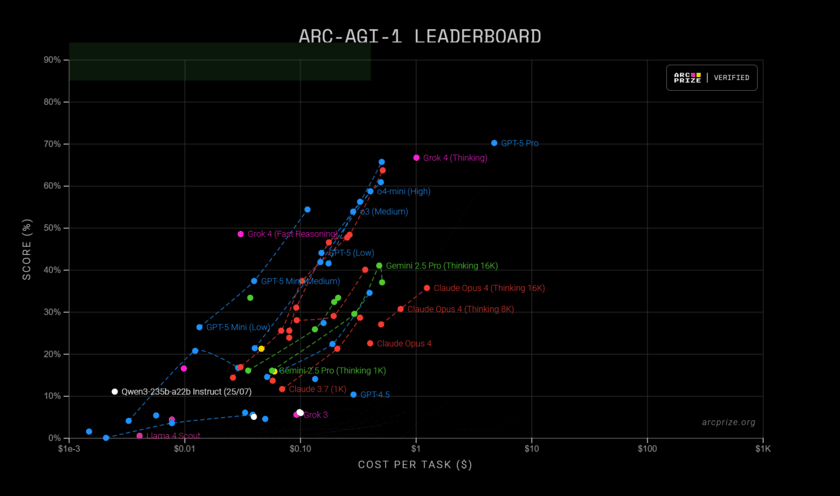
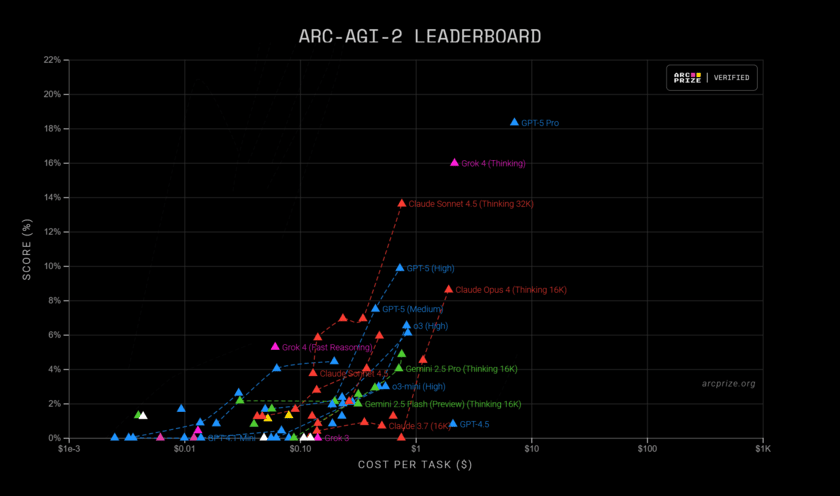
In other words, AI is highly capable when given well-defined tasks in formats it has seen before, but remains fragile when required to:
- Generalize from unfamiliar contexts;
- Balance conflicting constraints;
- Take a step back and reason about a complex system, such as a multi-million-line enterprise application.
4.3. Reliability, hallucinations, and the case for co-intelligence
These limitations directly affect developers' daily work:
- AI cannot gauge its own reliability. It may produce incorrect answers with complete confidence, sometimes backed by seemingly coherent reasoning.
- Models are highly context-sensitive: without precise instructions and relevant data, they tend to give vague responses or simply tell users what they want to hear.
For instance, the Stack Overflow Developer Survey 2025 reports that 84% of developers already use AI tools, yet 46% do not trust the outputs, and nearly half say these tools struggle with complex tasks.
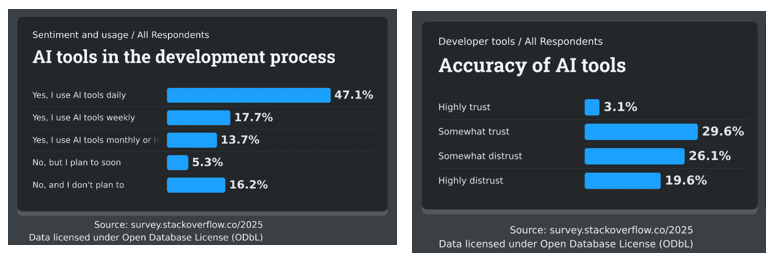
This underscores the value of co-intelligence:
- Either AI produces a result that humans verify;
- Or humans produce a result that AI helps verify and refine.
In software maintenance, the second approach is often more effective: AI serves as a review and analysis assistant, while the developer retains ownership of the final decision.
5. Security, compliance, and governance: Prerequisites for AI adoption
The primary barriers to enterprise AI adoption today relate to security and compliance: leaked secrets, personal data exposure, industry regulations, liability concerns, and more.
Key 2024–2025 trends
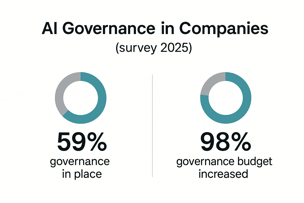
- Europe has enacted the AI Act to regulate AI use and strengthen trust in critical AI systems.
- All major paid model providers (OpenAI, Claude, Gemini, etc.) now offer contractual options that guarantee data confidentiality:
- No use of customer data for model retraining;
- Isolated environments;
- Limited and controlled logging.
With Visual Expert, these guarantees are reinforced through a DPA (Data Processing Agreement) that explicitly prohibits access to customer data for model training or any purpose not directly related to the service.
For DevOps teams, this means AI can be integrated into development workflows without exposing code or business data to additional risk—provided you:
- Select providers that meet regulatory requirements (GDPR, AI Act, etc.);
- Clearly define what data is shared with AI;
- Incorporate these considerations into security policies and architecture reviews.
6. AI adoption in 2025: Individuals and businesses
6.1. Individual adoption
Individual AI use has grown dramatically:
- An estimated 1 billion regular users worldwide, including 850 million using OpenAI products.
- In the United States, 62% of the population uses AI at least weekly (source: Pew Research).
- Between 19% and 27% of users report using it for work (source: Gallup).
Many developers now rely on AI to:
- Write unit tests;
- Get quick algorithm explanations;
- Scaffold functions or infrastructure scripts;
- Rewrite tickets or documentation.
6.2. Enterprise adoption
On the enterprise side, the picture is paradoxical:
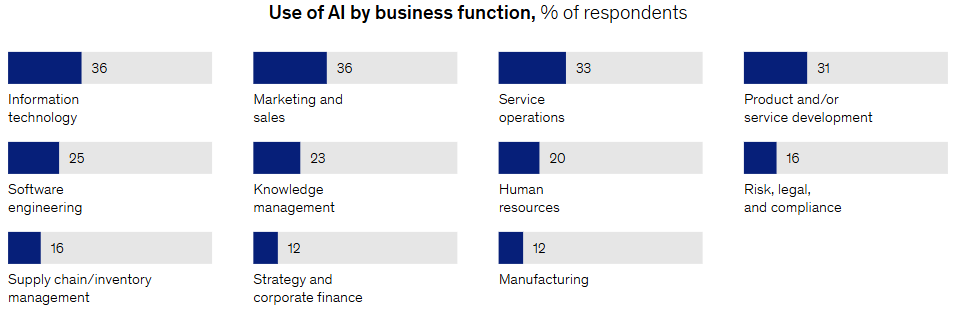
- 78% of companies already use AI in at least one function,
- including 36% in IT (source: McKinsey).
- Yet only 1% say they are 'fully' leveraging it (source: Pew Research).
- Only 12% of U.S. employees have received formal AI training (source: Pew Research).
- Still, 17% of companies report an EBIT improvement of at least 5% attributable to AI (source: McKinsey).
Key takeaways for development teams:
- AI is already delivering value, even in organizations without mature practices;
- The greatest gains will come from scaling adoption, training, and integration into existing tools (IDEs, CI/CD pipelines, code analysis platforms).
7. Applying AI to code analysis and maintenance
7.1. The limitations of 'raw' AI for developers
Asking a ChatGPT-style model to 'Explain this function' or 'Tell me the impact of this change' based on a simple copy-paste is inadequate.
Limitations become apparent immediately:
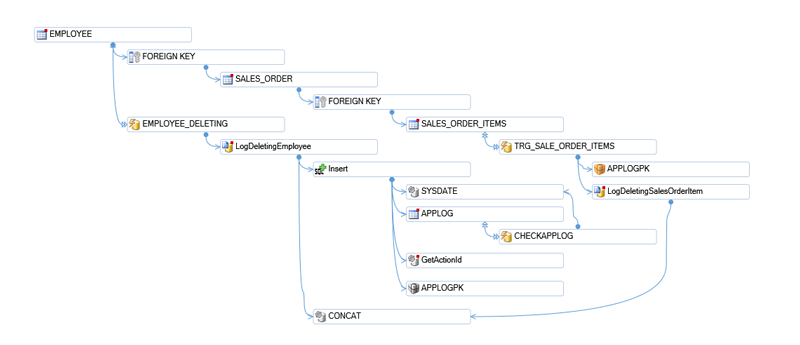
- Incomplete context: AI sees a snippet but has no visibility into dependencies, data models, or configuration constraints.
- Partial view: impossible to reason holistically from isolated fragments.
- Silent errors: AI may miss edge cases, tables, or triggers without realizing it—and without flagging what's missing.
For complex, mission-critical systems, the risk is operational: refactoring guided solely by AI may break functionality, cause outages, or degrade performance.
7.2. Why a tooled framework matters
For AI to be productive in application maintenance, it needs:
Complete, structured context
- Inventory of objects (procedures, triggers, tables, UI components, services, etc.);
- Dependency and call-path analysis (cross-references, call graphs...);
- Metadata on the application, data volumes, and performance.
Structured, controlled input
- Clear objective: explain, document, estimate impact, identify risk;
- Expected output format (list, table, summary with details, etc.);
- Explicit guardrails (do not fabricate, flag missing information, verify).
Integration with existing tools
- Invoked from the code analysis tool or IDE;
- With logging, traceability, and peer review support.
To meet these requirements, Visual Expert leverages static code analysis to supply structured application data to AI, enabling contextualized, verifiable responses.
7.3. Example: Integrating reasoning AI into a tool like Visual Expert
In Visual Expert, AI is encapsulated within purpose-built features:
- Explain the business logic of an object or procedure,
- Add comments to existing code,
- Propose and explain fixes for issues identified during code inspection,
- Optimize slow queries or functions flagged during performance analysis.
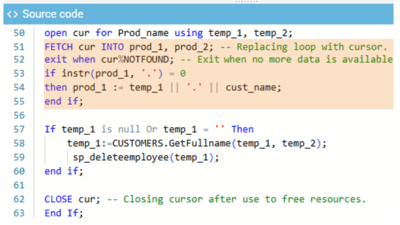
For each feature:
- Visual Expert automatically assembles the context (code, dependencies, metadata);
- Formats a structured prompt for the AI model;
- Returns a response that the developer can review, supplement, or revise.
This preserves a co-intelligence model: AI does not replace the developer but provides a higher-quality starting point, faster to produce, and aligned with the application's actual architecture.
8. Toward the first software maintenance agents
Today's features foreshadow the first software maintenance agents:
- Capable of suggesting fixes or preparing comprehensive refactoring;
- Validating certain assumptions (e.g., whether a change meets maintainability and security standards);
- Eventually, automating multiple steps in the build pipeline, especially continuous code checks in a CI/CD environment.
Near-term safeguards
In the near term, AI limitations dictate several safeguards:
- No autonomous execution in production;
- Mandatory review by a developer or architect;
- Validation through manual or automated tests (unit, integration, performance).
The goal is not to 'hand over' maintenance to AI, but to free up human time from low-value tasks (description, documentation, repetitive analysis), so expertise can focus on architecture decisions and business trade-offs.
9. Practical recommendations for developers, architects, and ops
Start with the right use cases
- Explaining and documenting existing code.
- Suggesting fixes for identified code issues.
- Recommending optimizations within a well-defined, easily validated scope—such as a single SQL query.
Use tools that provide context
- Prefer solutions embedded in your existing toolchain over standalone chatbots.
Establish a governance framework
- Define AI usage policies for source code and sensitive data.
- Select compliant providers (AI Act, GDPR, DPA, etc.).
Train your teams
- Build awareness of AI limitations (hallucinations, context dependency).
- Share best practices within a tooled workflow.
- Integrate AI into existing processes (code review, design review, post-mortems).
Plan a 6–18 month roadmap
- Phase 1: Controlled pilots with a limited scope (one application, one team).
- Phase 2: Scale successful use cases; integrate into tools and pipelines. Capture productivity gains on existing processes.
- Phase 3: Evolve processes to fully leverage AI/traditional tool combinations, with strengthened oversight.
10. Conclusion: Co-intelligence as a competitive advantage
AI will not replace developers, architects, or Ops professionals. However, teams that integrate it thoughtfully into their tools and processes will gain a decisive edge: faster maintenance cycles, deeper insight into existing applications, reduced risk in certain areas, and greater agility when facing major evolutions.
The question today is no longer whether AI is 'good enough,' but how to use it effectively:
- Within a solid governance framework;
- Embedded in existing tools and processes;
- Supported by solutions that deliver rich context;
- With humans remaining at the center of technical decisions.
Solutions that combine advanced static analysis with reasoning AI—like Visual Expert—point the way forward: they transform AI into a credible, productive software maintenance assistant that meets the security and compliance demands of modern IT environments.
Try Visual Expert AI Features
Request your evaluation version and test static analysis combined with AI on your own applications.
Frequently Asked Questions
AI is most effective at accelerating understanding or suggesting targeted improvements: explaining an object's logic, summarizing what a procedure does, clarifying implicit business rules, proposing comments, or suggesting optimizations.
However, for analyzing dependencies and safely implementing changes, you need tools that provide reliable mapping (static analysis, call graphs, code-to-data dependencies). Since AI only has a partial view of the code, it cannot "see" all references and won't flag side effects caused by changes.
No: it can assist or accelerate specific tasks, but guarantees neither reliability nor a global view.
The most effective approach is co-intelligence: AI proposes, humans validate—or humans execute and AI verifies. For maintaining complex applications, humans will remain the arbiters and bear final responsibility for the outcome.
By combining:
- A clear governance policy (what can and cannot be sent),
- Providers with contractual guarantees (DPA, no training on your data),
- Security and architecture reviews.
A chatbot only sees the code snippet you provide. Visual Expert knows the entire system's structure through prior analysis of the code and database (data model, objects, dependencies, methods, attributes, etc.).
AI is then used by Visual Expert to go further on "human" tasks: explaining business logic, generating comments, and proposing fixes or optimizations for issues found in the code.
It primarily serves to:
- Explain: the logic or business purpose of an object, procedure, etc.
- Comment: generate useful, consistent comments to improve readability.
- Fix: propose solutions to issues found during automated code inspection.
- Optimize: suggest improvements for performance issues identified during analysis of Oracle PL/SQL, SQL Server T-SQL, or PowerBuilder code.
By framing its usage:
- AI works on a precise code scope (procedure, object, etc.) with context provided by Visual Expert, containing all relevant information related to the analyzed code.
- It is invoked for specific tasks with detailed instructions (Explain / Comment / Suggest a fix / Optimize) rather than through open-ended chat.
- Results are formatted for easy review and validation by the developer.
A simple model:
- Schedule regular analyses (daily, per build, etc.) with Visual Expert to automatically map and verify Oracle PL/SQL, SQL Server T-SQL, PowerBuilder code, etc.
- Use Visual Expert's AI to address issues found: code and problem explanations, fix or optimization suggestions, etc.
- Systematically validate through review + tests (unit, integration, performance) before merge / release.
AI primarily accelerates "explanatory" and repetitive tasks: understanding an object, rephrasing, generating comments, assisting with reviews, suggesting tests, and local optimization leads.
However, it is not suited for tasks requiring a global system view (dependency analysis, refactoring, etc.) unless integrated with a dedicated tool that compensates for these weaknesses.
Bibliography
- Tracking AI – AI model IQ tests
Author: Maxim Lott, Tracking AI
Title: Tracking AI – IQ Test
Date: 2024–2025 - ARCPrize – ARC-AGI benchmark
Author: ARC Prize Foundation
Title: ARC-AGI – The General Intelligence Benchmark
Date: Updated 2025 - Stack Overflow – Developer AI adoption
Author: Stack Overflow
Title: Stack Overflow Developer Survey 2025
Date: 2025 - Pew Research Center – Public AI usage and perception
Authors: Colleen McClain, Brian Kennedy, Jeffrey Gottfried, Monica Anderson, Giancarlo Pasquini
Title: How the U.S. Public and AI Experts View Artificial Intelligence
Date: April 3, 2025 - Gallup – AI use at work
Author: Ryan Pendell, Gallup
Title: AI Use at Work Has Nearly Doubled in Two Years
Date: June 15, 2025 - McKinsey – Enterprise AI adoption and economic impact
Author: McKinsey & Company
Title: The state of AI in early 2024: Gen AI adoption spikes and starts to generate value
Date: May 30, 2024 - Pacific AI – AI governance practices maturity
Author: David Talby, Pacific AI
Title: 2025 AI Governance Survey Reveals Critical Gaps Between AI Ambition and Operational Readiness
Date: June 17, 2025 - OneTrust – AI governance budgets and priorities
Author: OneTrust
Title: The 2025 AI-Ready Governance Report
Date: 2025 - European Union – AI Act
Author: European Parliament and Council of the European Union
Title: Regulation (EU) 2024/1689 laying down harmonised rules on artificial intelligence (Artificial Intelligence Act)
Date: June 13, 2024