The only reason
for me staying in VB6 is the time migrating to .net
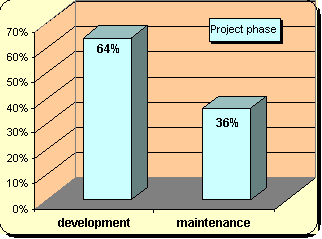
will require, and the actual phase development/maintenance
don't permit to take this time.
Probably i won't, probably new projects will be
developed usin VB.net and the old projects will
remain in VB6. |
US |
| I tried to migrate to .NET and I found that the
wizard is not good enough, it cannot generate something
useful and a lot of work was necesary to make something
that is ALREADY working to compile! |
US |
| .NET and VB.NET should also
support for Linux. |
US |
| I use both VB6 and .Net. New program i have written
in .NET |
US |
| As usual, the questions seek
a very pointed opinion and the flavor and significance
seems to be lost in the quest for brevity. The .Net
Framework and Visual Studio.net are just too important
a tool to be discussed in this manner. Most people
have no clue what it is and the kind of impact it
could have for them and their organization. I have
never been an evangelist but I am afraid that I
am running the risk of becoming one. I love the
product, the concept and I believe that Microsoft
got it right this time. It is only a matter of time
before .Net becomes the de facto standard for software
development. |
US |
| I see no advantage in moving to .net - unless
someone can show me one, i doubt we'll ever change. |
US |
| Visual Basic 6 is a rapid application
development tool. I was using this version for the
past 3 years. I find this version very user friendly.
Since I didnt get a chance to migrate to VB.Net,
I am not much aware of this new version. Any how,
I would like to work on this soon. |
US |
| I would have evolved to .NET but cannot make our
project from the scratch. The upgrading tool of
.NET is the worse thing made by microsoft. I know
that VB6 is dying and cannot do anything at the
moment. |
US |
| THanking you for survey from
other countrying. Nice day having. |
US |
| At first glance, VB.NET presents a real issue
of re-training. |
US |
Question 3 is not clear, what
do you want to know:
When are we shipping product .NET to user or when
do we start developing using .NET. Our time to market
is approx 2 years |
US |
| just too busy to get up on the learning curve
and convert my projects otherwise I would have already
converted just for the OOP featues to wrap everything
up |
US |
There is a lot of development
in our company, under government contract (and in
the government in general) being done with Visual
Studio 6 (not .Net), because that is how the project
started and they did not change the platform midway.
I think it will eventually become a problem.
My only problem with Microsoft's support is that
MSDN is not updated for Visual Studio 6. It's essentially
held at the Oct 2001 release. I have no idea if
I can expect more service packs for Visual Basic
6. |
US |
| Fear of the unknown is about the only barrier
to taking up .Net, once you dive in the water's
lovelly ;-) |
US |
| There are many ways to accomplish
a programming task. .NET is just one more tool on
the bench. |
US |
| I'm not a big time programmer, but have enjoyed
VB6 very much. It is unfortunate that VB.NOT was
such a huge departure from VB6. The VB.NET IDE seems
to take longer to startup (more bloated). I miss
not being able to step through my code, and dislike
how many commands have been replace (look how hard
it is to draw a shape). I've used VB Script for
programming Windows CE devices and it is no longer
supported. I'm very disappointed. |
US |
| use VB mostly for small applications |
US |
| PLEASE add the capability to compile to machine
code in .NET Development platform. Interpreted code
is simply NOT secure enough, even with obfuscation.
We will move to it as soon as that is present. |
US |
| vb.net sucks the arse... May
aswell use a real lanuage if not using vb for its
simplistic approach... |
US |
| We have both VB.net and VB6 in my org. My org
is <10% of the entire company, so my answers pertain
only to my small area. |
US |
| dotNet is just a Bill Gates
knee jerk ego reaction to having lost the java kidnapping
court case. Everyone knows that dotNet in its final
form is just going to be VC++ with some good internet
classes. |
US |
| .net range of base classes and documentation are
excellent. |
US |
| I expect our VB6 products will
still be shipping 5 years from now. |
US |
| I love VB. However, I am starting to do more c#
programming. |
US |
I'm developing For Fun in my
place....
i just love my pc ;) |
US |
| We develop standalone tools for our salesforce:
.Net is a bloated architecture that has not done
any better than java at overcoming the performance
obstacles of an interpreted UI. Ultimately processing
power and inclusion of the .Net Framework in the
operating system may overcome these problems, but
there is a constant battle with every other application
to consume all available resources. |
US |
| I use both VB6 for maintenance
of older projects and tweaking and VB.NET for new
projects. I prefer .NET as it's faster (now that
I'm up to speed with it) and also it can produce
much more professional looking results. |
US |
| the structure of this survey is very biased. You
should NOT limit the choices to a single item, on
each question, as several are equally applicable. |
US |
| I like VB6 because all you need
is the VB6 runtime to work. It is a reasonable language,
except that it does not do very well with classes
and objects. If it were totally object-oriented,
it's perfect. VB.NET is good because it is object-oriented.
But there is the fact that you need the .NET framework
(and the right version of it) on the machine to
run the application, and the application does run
a bit slower. |
US |
Yes. I feel that Microsoft is still in the HYPE
stage of .NET and is not providing correct info
on the % of programmers that have moved to .NET
technologies.
WE develop desktop stand alone financial planning
applications and do not see any intregal benifit
from moving to VB.net. However, we will probably
be forced to the .NET technologies because Microsoft
will not be supporting VB6 forever and interest
in it will wain.
.NET iz impressive but has lost its RAD properties. |
US |
| I m new in this section, i did't
have any specialized tranining |
US |
| MS has not provided any understandable/useful
knowledge of .net, or its benefits to those not
working on www applications. I'm still trying to
find MS or other info on regular expressions Perl
type scripting for VB6 database type applications,
the old Commodore, TRS80 type string handling commands
are limiting. Don't know if .net would help. MS
need to publicise the benefits of their .net product
better. |
US |
| I enjoy using VB, it is a simple,
straight forward language that allows quick results.
I personally have never found the lack or Object
Orientation to be a particular detriment. |
US |
| I would never go back to VB6! |
US |
| bad feature: the use of unmanaged
code, espacially String-conversion |
US |
| I use VB from time to time as a reasonably useful
RAD tool. I have no interest in VB.NET and see it
primarily as a move by Microsoft to force users
to move to new, incompatible technology. On balance,
for the kind of work we do, I much prefer Tcl/Tk,
as it is just as simple to use as VB, free, open
and cross-platform. I would urge developers disgruntled
with Microsoft tools to check it out. |
US |
| I am not yet sold on object
oriented programming. It seems like things that
used to be easy in VB are now extremely complicated
and difficult in .Net. |
US |
| I have heard a lot of horror stories from professional
programmers about the problems associated with converting
VB 6 applications to VB.Net. Microsoft's misrepresentations
about the ease of the task have not helped. Since
all of the applications I have developed are in
VB 6, I will not consider making the switch until
we have a new concept that would be designed from
scratch with VB.Net. And we will probably not be
using any of the new web-aware features of the language. |
US |
| We envisage to move away from
VB6 (except for maintenance) and all new development
will be done in C# or Java, because the learning
curve from VB6 to VB.NET or C# is about the same.
It's easy to cross-skill developers between C# and
Java and vice-versa. .NET projects tend to be easier
to deploy. However, prior to .NET, VB6 was the best
tool to quickly develop Windows-based applications.
I personally use VB6, VB.NET and C#. I prefer C#
over VB.NET. |
US |
| everything about MS programming is good BUT hate
the way microsoft launches newer OS every now and
then :( |
US |
| Spending a considerable amount
of time looking at .net and trying to get my head
round it. Not yet convinced about the benefits.
Its bigger, slower and much more complex, but not
found much on the plus side yet! |
US |
This questionnaire appears to be geared to determine
who is moving from VB6-->VB.NET. My path is VB6-->C#
and is not apparent from this questionnaire. A lot
of people are moving to C# as opposed to VB.NET
and you're going to miss them here (or maybe you're
not really intrested in .NET generally - just VB.NET???)
Also - The 'Benefits' section only allows 1 selection
- there are dozens of other good reasons to move
to .NET and associated tools.
You should also ask what percentage of time is spent
in VB4/5/6 etc
Generally this is a very, very poor questionnaire
and i'm not sure what 'real' statistics can be taken
from it and/or read from it. Still I'll click the
Submit button and see what happens! I guess this
is just a sales/marketing tool to meet your own
ends?? |
US |
| I love VB6. I without the ability
to create apps without depending on the .NET framework,
I am not interested in VB.NET except for web-based
development. |
US |
| We use both right now. But would prefer to be
entirely in .NET |
US |
| Again, the survey needs to have
more check boxes and less option buttons... some
of the questions had more than one answer. |
US |
| VB6 itself is a great modeling tool. .NET development
takes longer, and we are still having problems with
.NET instability. MS software in the past has been
better. I am not sure I understand the QC problems
they are now having. |
US |
| VB6 does all that my App which
I sell needs to do, so I see no reason to switch
to .net |
US |
| I think VB is great! I have been using VB since
version 3, have had most experience with version
6 but have been moving to .NET over the past year.
I can't knock VB6 and in some respects it is more
friendly to use than .NET - but, .NET brings loads
of exciting new developments to the equation and
in a couple of years I'm sure I won't have any cause
to be using VB6 again. |
US |
| I don't have enough time to
spend learning the .NET framework and have been
fornced to maintain my coed in VB6. We have to move
to .NET soon, so it will cause a complete work stoppage
while we retool the apps. Bad planning on Microsofts
side, and I resent their approach to VB. |
US |
| Regardning quick application development, I think
VB.NET is a step in the wrong direction. Nothing
beats the VB6 debugger tools. |
US |
| I think VB6 is the best VB ever
and I can't see why we need to go to .net just because
MS says it's great. There seems to be a lot of headaches
that will accompany that conversion and I'm not
going to jump into that. |
US |
Bugs present in VB4 are still there in VB6...
and some of them make your programs look un-professional.
VB should be able to deploy like RealBasic - WITH
THE .EXE FILE ONLY. All this .dll garbage is also
very un-professional. |
US |
| I think the move up to the next
version or else model that Microsoft uses is causing
me to look more at Linux development. I do not like
to have my investment in money, time, and effort,
made obsolete. I am willing to advance, but do not
like feeling like I'm losing all of my effort if
I don't go with the latest and greatest bug. |
US |
| VB6 still alive ! |
US |
| I'm still using VB6 as well
as .NET, your survey needs to allow for the selection
of both. |
US |
| VB 6.x very useful for small or midsize project.
We use VB 6.x only to support our projects that
was developed before appearance of Microsoft .NET.
For current projects we use Visual Studio .NET and
C#. |
US |
| All our VB6 is legacy, but will
likely be around for a while since it is useful
for using old-style classic COM objects for some
of our legacy products. All our new development
is C#. |
US |
| As a company we decided to move from VB completely
and make the transition to C#. We saw the power
of C# and the ease of development of .Net with Winforms
and decided to use C#. VB6 was a good tool however
there was many limitations such as OOP, specific
keywords... VB.Net was intruiging to us however
we just thought that C# was a better language and
was a better fit with .Net. The syntax is much more
universal (similiar to Java and somewhat C++). |
US |
| Look forward to a balanced result
not like most marketing gimmics. |
US |
| I wish that MS would update VB6 for those of us
who may not be able to go to VB.NET right away.
I hope they continue supporting it. |
US |
.Net is the absolute future.
Look at longhorn, I can�t see a software house survive
without .NET.
Development time in .NET is reduced - in proven
cases I�ve worked on - by at least 50%. I can develop
an application in .Net in one week, that would take
at least a month in VB6. |
US |
| .net is great. but the speed degradation for windows
applications is noticeable. requires all our users
to upgrade hardware to meet performance desired.
not likely anytime soon. and not every piece of
software should have to be managed, would like the
option myself as a developer. |
US |
| The main reason we are still
on VB 6 and haven't moved on is that we don't see
that the benefits justify the learning curve. |
US |
| I must very disappointed to hear that VB.net does
not support arrays of Controls; they're so powerful!
VB was built for easy GUI development; VB.net seems
like it's making GUI development MORE difficult. |
US |
I have dropped VB 5.0 in favor
of the PowerBasic compiler.
.NET concerns me because it seems that non-Microsoft
compilers
will be discouraged as development tools. The Windows
API, of which
I have spent much time learning may even become
obsolete, which means
valuable training and research may be wasted. |
US |
| Your survey doesn't provide for this but I use
both VB.NET and VB6 - currently doing projects in
both. |
US |
| I've been using vb.net for over
a year and I've had no complaints. I haven't ported
much to .net though only new projects. After getting
past the learning curve .net is much easier to develop
with and being able to have a more true OO language
is welcomed. The only thing I miss is breaking and
changing code and then being able to continue without
a totaly rebuild. |
US |
| We're ready for VB7, however Microsoft continues
on the VB.NET tract, |
US |
| We decided to switch to C# as
native .Net language. The reason is that VB.NET
doesn't resemble VB6 at all, so mastering VB6 has
no added value to moving to VB.NET being an entirely
new language. |
US |
| I would love to see MS make a VB6.5 to help the
transition to .Net |
US |
I have developed a development
utility which allows programmers familiar with generic
'Business Basic' to convert these programs to Visual
Basic 6.0. The ability to emulate Business Basic
verbs with Visual Basic routines and syntax is very
high...IF we stick with VB6. Once we try to use
VB.NET, the 'look-and-feel' is not even close.
See http://www.kolafa.com/Downloads/ReadMe.txt (Note
2)
Don Kolafa |
US |
| VB 6 is still an excellent product and should
be around for a long time. |
US |
My main problems with .NET are:
1. I couldn't immediately see how scroll thru records
programatically in ADO.NET and know which record
the user is on.
2. There is no 'in line' bug fixing (while the prog
is running)
3. It is slow to compile the app. When 2 of those
three issues get addressed (and future faster hardware
will help) I will be willing to go thru the slow
painful process of re-learning everything in the
new .NET world.
BTW I have lots of apps out there with customers
(in maintenance) and a couple still under development. |
US |
| I'm happy with VB6. The reasons to want to upgrade
is two fold. Staying with VB6 long term would be
like remaining with DOS apps 10 years ago - have
to change to keep up. The main reason to look at
changing earlier is the drop of support for ActiveX
components by many 3rd party component suppliers.
Their .NET versions often have new features they
have no intention of adding to their ActiveX equivalants. |
US |
| I still love working with VB6.
There was much excitement moving from VB5 to VB6
- but moving from VB6 to VB.NET hasn't produced
near the excitement. We in IT know that we always
have to continually learn new technologies, but
we also want to take comfort in technologies that
are getting the job done - like VB6. Remember, VB6
soared when IT was the latest and greatest career
choice. That is one reason for the success of VB6.
Since the IT economy essentially flatlined after
the glory days of the 90's, programmers and companies
aren't near as qucik to invest time and money into
new technologies - like VB.NET. |
US |
| The whole concept behind the .NET development
is superb. The resulting software really empowers
the stand alone developer. This is the most exciting
thing Microsoft has ever done. It will result in
a quantum leap in software perfomance and reliability. |
US |
| vb6 needs some advanced programming
improvements but is stable, reliable, flexable and
needs little maintanance if 3rd party controls are
not used. |
US |
| Microsoft is a marketing company, not a computer
company. They are introducing .NET mainly to create
a whole new business/income stream. |
US |
| I would love to use VB.Net but
it is extremely expensive for me. |
US |
| I love vb6 because it is so straight forward,
but because of the .net improvement in front end,
I might have to consider learnig newer language
to migrate eventually, ....oh well, I guess it is
a sign of the times...;( |
US |
| VB 6 is a greate language ,
but lacking some certain areas , like inability
inherit , function overloading but i think .net
have nicely implemented those |
US |
| Move to C# |
US |
| I don't like VB.NET for it's
debugger... you could alter code during testing
runs in VB6's debugger, but no, Microsoft had to
change that... Imagine the complication of rebuilding
a large project just to change one variable behaviour...
make it so 5-6 times per working day and all you've
been doing the whole day was rebuilding the application.
NET sux |
US |
VB is excellent language i have seen with lots
of supportive features.
I dont know about .NET as now am in testing. But
3 new projects which started in our company were
in .NET and some Projects were rewritten in .NET
Hope .NET will have good feature too. |
US |
| We will be staying with VB6
until such time it cannot do the job or our clients
say we should move to .net. |
US |
| Till VB.Net settles down I will stick with VB
6. |
US |
| Microsoft should rethink .net
and worry more about system integration issues with
their flagship products. |
US |
I am a doctor and an amateaur developer ( migrated
from Clipper some years ago) of VB6 applications
running on the
network at my hospital. At the moment I have 9 application
in use (some rather big) , but rather soon professional
softwares will take over most of my programs - so
the future for my hobby is threated. The other reason
is that I am 61 y - has invested quite a lot i VB6
books and knowledge - so the inclination to learn
something new is not too great. |
US |
As we are a very small software
development company, we generally only operate on
a maximum of 2 projects at a time.
It took us a while to get used to .NET, but now
we can do the entire development phase in half the
time as was possible with VB6 or Borland C++ or
Delphi. |
US |
We use and will continue to use both VB 6 and
VB.NET
As a consultant I will recommend to most clients
needing standard EXE apps that VB 6 will meet their
needs much better than VB.NET ( VB 6 apps being
faster and requiring less memory on computer )
As a developer of components ( OCX and .NET ) we
will continue to develop, market and support OCX's
for VB 6 as well as .NET components. |
US |
VB6 still fine for 3 tier client-server
to SQLServer - performance on todays PC is fine.
ASP, XML with Flash does web,
so .NET (= .TRAP for Microsoft) - prefer non-branded
solution. SOAP is also good for using VB middle
tier - swapping out the VB GUI layer. |
US |
| Is good if we can get rid of Deployment Tools
and across OS platform. |
US |
VB6 is a very good tool for
windows develop, and i like it , it is easy to use.
and no need much support system,
easy to use activeX componense |
US |
| vb.net is awesome |
US |
| VB.NET will be a long tortuous
path, for developers to follow. |
US |
�'m very interesting in upgrade to .net but we're
developing and having not time to learn the new
version now,
but i like to know the time spend aproximately in
to learn it. Sorry by my English I'm Chilean |
US |
well, for me althought we've
been trained on .NET but still there is resistance
as to the current requirements.
we need sometime to completely and totally moved
to .net as single tool for development. |
US |
Many bugs in the DB area.
When working with database must do loops and hoops
to overcome it. |
US |
| VB.Net only used for new developments.
Ongoing projects & maintenance with VB6. |
US |
| I think use several language in one project,please
introduce some experience about it,thanks! |
US |
Hope VB.NET has the convenience
of editing while debuging.
This is the key point we love VB and do not like
to loose it in .NET. |
US |
We are heavily vested in COM, RPC, SOAP, and ActiveX
Controls. Migrating to .Net
will be costly and time consuming in the short-run.
However, we are also investigating development in
other languages entirely |
US |
| I like VB6 and can do everthing
I need to do with VB6 |
US |
It's a darn shame Microsoft would just give up
on VB6 and leave everyone the way they did! VB6
has such solid foundation, and so many users! I
think they should continue to maintain VB6 to support
the millions of applications that are already written
in VB6.
Just because they come out with a new Dev Platform
does not not mean that it's the best thing for everyone
else, and I see it as MS turning it's back on what
they started. |
US |
I'm finding many shortcomings
in .NET, but I'm still willing to use .NET occasionally,
when it is advantageous to do so,
otherwise, I still slam new projects out with VB6
or Access, whatever my clients want. |
US |
| I also just updated an exising VB6 application,
deciding not to convert to .Net because of time
constraints. This was part of a large database project
that my client was using a lot of offshore people
to program. They were all still using VB6 with SQL
Server. |
US |
| Not sure if I undrestand the
central question--.NET is not a language, it is
a development/deployment framework. VB is supported
by the .NET framework, just as are C++ and C#. .NET
permits developers to use their language of choice--again,
.NET is not a language. |
US |
| I planned to upgrade to vb7 but it obviously never
came out. What happened? Is NET the vb7? Where can
I find out about NET? |
US |
| Creating DLL tools for ASP or
Windows is the easier alternative to deliver quick
results. |
US |
| I think for some of your questions, you should
provide the option to include more than 1 answer
- e.g. #1, I use both VB.NET and VB 6 for projects
but given that I only have one choice, I choosed
VB.NET. Another question I would be interested in
would be reasons why they have not migrated to .NET
yet. |
US |
| Management are terrified of
.Net. The developers understand it, management does
not (nor do they need to, but that's another story),
therefore it does not get implemented, and is actively
blocked. |
US |
| Microsoft should release VB 7.0 as a true descendant
to VB 6.0. Fix the bugs and finaly add true class
inheritance. Then I would have the best tool for
maintaning and upgrading my projects at Svenska
M�tcenter. |
US |
| We are currently using VB 6.x on project because
customers still use this development tool for developing.
Some customers are using VB .Net, but not all of
them. Also customers using VB 6.x don't want to
migrate to VB. Net. |
US |
| I feel there is no proper easy
support for interfacing low level machines via LPT/COM/USB
ports or need to write codes in C! means no use
of VB migration to .NET |
US |
I use VB/Delphi/Alpha 5 for small apps to do specific
jobs.
I have long been thinking that these tools are getting
too complicated and there is too much overhead.
I long for something that is quick and easy, some
database facilities, etc
I shall NOT be using .NET instead i shall be looking
for tools ahat are uncomplicated and easy to use.
Now where did i put my copy of ObjectVision |
US |
| I see no real benefit in using
MS tools at all. I used to be a VB6 man, using MS
Access as a database. Now I use Java, MySQL, PHP
- all free, open-source and OS-independent - Microsoft
VB6 come in handy only to show my client how to
things can be done (as a GUI, non working sample...) |
US |
| Thank you |
US |
| we're gradually moving components
to c#, which has found great favor among our developers
(for expressiveness, syntax). we'll migrate some
of our vb6 components to vb.net to allow easier
integration with our ASP.Net site. All of us are
glad to escape VB's frustrating limitations. |
US |
| I am currently using both VB 6 and VB .NET. I
admit that my education in .NET has been been a
slow one. |
US |
We are in the printing solutions
business. We have no driving need to move to .Net
as our customers do not use it or the overhead baggage
that is required to run it. VB works fine for 95%
of our projects and in fact we use MicroFocus Cobol
in a 'Dos Box' for some projects. This may sound
ridicules to some but we are not in business to
follow trends. We do have some ASP products that
may benefit from .NET but there is no driving force
to migrate these products at this time. The biggest
improvements we might see are user interface enhancements
versus the clunky style of ASP and HTML.
We provide solutions and answers that's how we stay
in business. I have yet to encounter a customer
that demands .Net. But don't get me wrong. Depending
on what business you are in .Net may certainly be
needed. For back end production work we have not
yet encountered the demand. Maybe one day we will
and as we see that curve develop we will migrate
to it as it probably is inevitable as MS continues
development. Following the latest trend sometimes
has no place in production, efficiency and profitability.
As for the trade press you are right, you would
never know VB is still used. But that media doesn�t
get out on sales calls and sell solutions. It�s
market is the techno junkie. There is a need as
technology moves on though. Customers for the most
part don�t care at all if this object can do this
or that and this is a topic a lot will disagree
with me on. The bottom line is the techno junkie
is paid by sales and customers have a business to
run.
|
US |
| I'd like to see more develo0pment with Access
and VBA |
US |
| Hate to see VB 6 going away
but it's not upto us to decide. However, not every
company is planning to completely migrate their
business to dot net and that's a good news for now
for all VB6 developers all arround the world. |
US |
| I used to use version 6 because of school, but
now that i'm graduated i got my own version of vb.net |
US |
| I love it I love it I love it
I love it I love it |
US |
The superior about the VB generation is the ability
for a programmer to create applications in no time.
This means that the developing-time from getting
an idea to creating it is so much smaller than if
you had been using c++ or another language.
I'm working at making some electronic game and by
using 10-20 min developing it in VB first I can
quickly judge which features that are necessary
in order to make the game work proper. |
US |
| Other than the new stuff they
offer in re .net technologies, I don't see any reason
to move to the new versions of VB; perhaps my biggest
draw is philosophical, because now they offer true
oob in the language. |
US |
| Our software program must run on all versions
of Windows all the way back to Win 95. Therefore
we can never convert it to VB.Net which only works
on the later releases. Also the conversion process
is famous for not going smoothly. Our program is
very large and it will be a big task to convert
it. See our website for more information on our
program. www.servicelife.co.uk |
US |
| Although we still use VB6, we
are migrating to VB.NET as we upgrade our obselete
systems. Developing web applications with .NET has
allowed us to develop robust client/server programs
utilizing a web browser, ending the deployment of
applications on client machines. |
US |
| The .Net Framework has many troubles with dll
function calls. IDE works very slow. No Edit & Continue
in current vetsion. Good luck! |
US |
| It would be nice to have VB6
going for a few more years. |
US |
| Having a million or so lines of code (just a guess
but we have been creating / extending / maintaining
this product (Printcost) for over 20 years) the
cost of converting to another language is astronomical
There are some fundamental changes that affect us
in a major way - like using indexed controls. |
US |
| VB is a great tool for rapid
development. Now as far as new technology is concern
everyone is goin for globilization and the use of
internet. for that purpose we have to switch to
.net or any other internet related technologies. |
US |
| The report designer is the worst thing in VB 6.0,
microsoft did not concentrate on building a powerful
report designer in vb 6.0, crystal reports maybe
better. |
US |
| Microsoft developed a very good
application with VB6 and are now moving to web based,
My company only use VB for small interim developments
to fill gaps in the larger systems and so web based
is nice, but by far not essential. The cost of developement
for VB is very small and hence we develope systems
on OPEX without the need for projects. I doubt very
much .NET would allow us to develope quicker and
cheaper.. |
US |
| We will be running our VB6 projects at client
sites for at least another 5 to 10 years, but new
clients are not interested in the VB6 products anymore
- we are only selling dot Net stuff |
US |
| We are currently working on
several projects. New ones are developed in .NET.
Existing ones are maintained with VB6 |
US |
| VB6, excellent development tool both in the Visual
Basic and VBA environment |
US |
| I think we all had better learn
vb.net fast! And it's not that hard. |
US |
| I don't think Microsoft understand that not all
companies have the resources available to constantly
be migrating platforms. We have spend 4 years on-going
development with the systems we run and to migrate
everything to .NET is an insumountable task. We
will have no choice but to continue to develop and
maintain our systems in VB 6 with or without Microsoft
support. |
US |
| When is VB 7 coming out? Why
not buy out Power basic and make VB programs not
dependent on runtimes? |
US |
| I use both VB6 and .Net VB6 for small in house
apps and C# (.Net) for webpages |
US |
| have not yet uesed any of the
above tools. |
US |
| Why migrate when there is little benefit. The
cost of retrainnig and the cost of the tool itself
does little to provide any added value to the customer
or to my business |
US |
| VB6 is still the most productive
tool balancing ease of deployment |
US |
| The additional programability found in VB.NET
would be nice to use in VB 6.x, but I would not
want the .NET framework, as it seems to be a limiting
factor. |
US |
| I have decided not to go through
another Microsoft update cycle. I have enough invested
in VB6 enough challenges in using it that upgrading
to VB.net seems too expensive and painful. I would
rather switch to Java. I believe Java is not marketed
this way. |
US |
| Do not give my email address to anyone .. do not
need any more spam! |
US |
Most of our work is in Access
VBA. I studied like crazy to get up to speed on
.net-- but we just aren't moving into it.
If there was a customizeable accounting package
in .Net that we could do VAR stuff with, then we
might have options, but the package we currently
support still hasn't rolled out their dot net version.
It bothers me that we are in this situation when
MS has been saying for years that all new development
needs to be done in .Net. We do have an in-house
project in .Net and also an ASP.Net project we did,
but there is no interest in our mgt. to try to do
more. |
US |
| VB is a great language, the best for me, is simple
and powerful for my job, and it's not create fool
programs!. Unfortunately, someday Microsoft will
retire the support to the developer community and
we must migrate to .Net |
US |
VB6 is very useful. It can stay
as VB6 and it will do find. I treat it as an another
language in it self to use for Rapid Application
Development; not as a version of a computer language.
VB6 will be here forever because its not .Net dependent,
the language is easy to use, and because you can
create high caliber software in faster time than
any other language. VB6 will be use as a language
of choice.
When you see people donate real good and innovative
programs and codes, they are usually in VB6. Microsoft
have missed the point with .NET, they have neglected
to respect VB6 itself as a platform.
If some how MS is able to allow VB6 code to run
as it is on .NET without any code changes, then
maybe people will view it as real 'improvement'.
I have seen and used VB.NET, its cumbersome and
time consuming to use. If I want to accomplish something
on a code for a program, I usually can find and
understand an answer/sample use for VB6 than for
VB.NET. Thats the case because many people can understand
VB6 easily and get on track to write good code.
Not .NET.
MS can only capitalize on VB6 if they only understand
and produce software development program that provide
the tolerance for imperfect code and the high probability
of running code effectively like VB6 and its IDE
does. But I doubt they will do the right thing. |
US |
| We actually use both VB 6.0 and VB.NET. New applications
are developed in .NET but migrating older applications
is somewhat difficult and are being developed in
VB 6. |
US |
| We like VB V6 a lot and hope
Microsoft continue to support it for a few years |
US |
| My projects are decidedly small for local small
businesses that cannot afford the huge and expensive
programs similar in content to MS Office Pro. Suites
of that type are a waste of their finances because
they contain too much that is not required by these
people. |
US |
| We have multiple VB projects.
The only VB.NET projects are for in-house only at
this time. All of our projects developed for customers
are only being developed in VB6. |
US |
| Thanks... no more |
US |
| Your survey should use a spell
checker, and questions should 1 and 9 be multiple
choice. There are good business cases for VB6 and
.NET. The issue should be which one best fits the
project's needs. |
US |
| VB.Net ROCKS ! |
US |
| We currently use StarTeam for
version control- it is a much better product than
VSS. |
US |
| I do VB6 programming for our personal household.
.NET seems pretty complex for what I need. I do
significant projects (85 KLOC, 11 KLOC), both VB6
standalone and MS Office coding [excel, word, access].
What I've looked at for .NET seems overwhelming.
It might be useful for business use, but I STILL
want something robust for home use. I don't quite
need industrial strength. VB6 is quite good - except
for needing better (more packaged) facilities to
get to Windows system information and features. |
US |
| One of the major problems I
see in upgrading from VB6 to VB.NET is the code
and component conversion. My OCX's I used in VB6
won't work in VB.NET and code conversion is not
automatic. I like that VB.NET doesn't suppose to
need DLL's, but even C++ needs MFC DLLs, so will
that make my VB.NET distribution much larger than
in VB6? Who knows. I can find very few answers to
these questions, and when I do, they're not ones
I want to accept. |
US |
| One of the major problems I see in upgrading from
VB6 to VB.NET is the code and component conversion.
My OCX's I used in VB6 won't work in VB.NET and
code conversion is not automatic. I like that VB.NET
doesn't suppose to need DLL's, but even C++ needs
MFC DLLs, so will that make my VB.NET distribution
much larger than in VB6? Who knows. I can find very
few answers to these questions, and when I do, they're
not ones I want to accept. |
US |
| microsoft's biggest mistake
is dropping VB6 for VB.NET. compare today's environment
to that of 2008 and you'll see. |
US |
| VB 6 is still a very viable tool for small business
development, VB.NET is too complicated and over
kill for that niche. |
US |
| VB.net is great, but its deployment
side is a bit heavy due to the framework that you
need to install. Overall more productive than VB6. |
US |
| VB.NET component developers are slow in providing
ALL the shipped vb6 functions in their released
.NET components. They have ruched to market with
incomplete products and poor documentation. It is
very frustrating providing the same functions in
the .NET part of the program as we do in the VB6
part of the porogram. We ship a joint VB6/VB.NET
package. All new development is in the .NET module
and as current functions are added to the .NET part,
they are removed from the VB6 module. Duplicate
menu pages send the user to the correct module and
utility. |
US |
| I'm not a professional programmer.
I just use VB to make a few programs for my computer.
My last version was VB4 which I used on 1996 computer.
I now have a newer 2002 computer and figured I had
better get the latest VB version for it and so bought
.NET |
US |
| I still USE VB6 for some kind of projects which
are mostly based on my exising framework library
developped till the date. Use this is faster to
develop new project and offers fewer testing/development
cycle. If it is brand new project then I use the
VB.NET. And ofcource afer 1-2 years .NET will only
be my development language as my framework is virtually
ready for every new project. I realy imppressed
with the fewture exist in the VS.NET IDE. |
US |
| I'm an occasional programmer
and VB.NET is just to expensive and difficult to
make it worthwhile to change from VB6. I�m looking
at some other language/framework (REALbasic??) maybe
I�ll just stick to VB6 until it�s no longer viable? |
US |
| I think development in VB is quicker than NET,
at least for small-medium proyects. |
US |
| Your survey is not flexible
enough to reflect my actual usage. I work as a consultant
in a group doing Microsoft-based custom application
development and systems integration for multiple
clients. My colleagues and I actively use VB6 and
.NET (VB.Net, C#, and ASP.NET; .NET Framework 1.0
and 1.1; Visual Studio 7.0 and 7.1). Furthermore,
I find clients are also using VB6 for support and
extension of legacy COM+ as well as doing new development
in VB.Net, C# or even J2EE. |
US |
| It is like I have heard from a lot of people that
used VB6 extensively: Why would you use VB.NET when
you have Java? VB6 filled a niche - there was nothing
else like it. Sure it did not have classes, overloading,
and so on - but if anyone was and is going to need
objects, we have and will use a true OO language,
like Java or even C++ |
US |
| I think MS is making a mistake
'forcing' developers into the .Net corner. It might
cause their 'loyal' developers to junk VB and go
with Java. If I need to learn a 'new' VB, I might
as well learn Java. |
US |
| We will probably try to migrate to VB .Net later
this year. If it wasn't so steep a learning curve,
we would try to move to it for my current project. |
US |
| I haven't switched to VB.net
since I don't work in a multi-member development
team which VB.net seems to have an advantage. Using
VB6 in a single developer environment allows me
to produce significant windows programs in a very
short period of time. |
US |
| We cannot justify the man months to upgrade our
app to vb.net. We need the ability to run VB6 code
directly in vb.net...fat chance! |
US |
VB.NET offers limited benefits
given:
1. cost of re-training
2. effort to rewrite existing base
3. effort to support dual platforms with one platform
constantly changing
Why won't MS take a VFP type approach (enhancements
w/compatibility) to VB vs. huge change? VB.NET is
just C# with a different syntax. Let VB be VB (hint:
the B stands for BASIC). MS missed or is missing
marketplace for development tools for average (hint:
BASIC) development previously held by VB. I understand
and appreciate all the cool VB.NET technical features
- BUT!!!! - where's the real world ROI? For small
and medium businesses I just don't see it.
Speaking as CTO of a 15 year software development
firm, MS needs a VB 7.0 that builds a BRIDGE to
VB.NET vs. the huge chasm they've created between
VB 6.0 and VB.NET.
Happy to discuss my thoughts further.
Malcolm Greene, CTO
Brooks-Durham Software
[email protected] |
US |
| If only VB.NET wasn't so incredibly different
for the kinds of projects we need to create, we
would have converted already. We use Crystal Reports
integration heavily, and many of our projects are
1-3 day custom reports/utilities for customers.
I develop many products as well, that range in size/complexity. |
US |
| I would like to hear the advantages
of moving to .net. |
US |
| I hate .net!! There is too much stuff and it takes
too long to create a simple project! It is also
hard to make sure it works on other servers. I will
go to another product before I go to .Net. |
US |
| we are currenlty using both
vb6 and vb.net, that should be an option for the
survey |
US |
| Our projects usually involve interfacing computer
systems running VB programs to industrial sensors/measuring
systems. These require little in the way of internet
capability. |
US |
| We do new development in VB.Net
but it is not feasible to move our entire suite
of applications developed in VB6. Lack of complete
migration tools hampers our efforts. |
US |
| I use both VB6 & VB.Net, I still like VB6 very
much. |
US |
| Yes dotnet is the future but
vb6 is the present |
US |
| Pretty much for network intensive projects, we
find PowerBasic's built in networking functions,
which support both inline and callback (object oriented)
network models, is superior to any other language.
It also supports in-line Assembly and of course,
like other languages, has no problem allowing direct
API/SDK access. And it usually compiles to smaller
binaries than any high-level language. |
US |
| Would love to learn .NET but
time is scarce |
US |
VB6 is now a very old programming language, but
if you use
Win32 API and a little hooking and subclassing,
you can achieve almost anything - when programming
Windows based applications. The embedded ActiveX
controls are a little outdateted, but with just
a little work one could make superior controls in
no time.
So, you see, I have no real need to move on to .NET,
or anything else for that matter. Since I am still
working on some applications for Win95/98, I don't
think those old machines could chew something as
robust as the Framework. |
US |
Why does your survey assume
you only can use one type of VB.
Personally I presently use VB6 and VB.net.
If section 9 you ask about VB projects, however
the third question assumes you only have one project.
I have projects I am maintaining and other projects
that I am actively developing.
I must say this is the worst survey I've ever written. |
US |
I typically write small interfaces that allow
companies to configure embedded products that I
design. I want to wrap these up in a few hours.
I don't want to get too involved in using the macros
required to talk to the comm port in vb.net.
I have used .NET and found it cumbersome for doing
applications that talk either over usb or the comm
port to configure devices.
I am avoiding the pain of moving right now. |
US |
| No plans to move to .NET at
this time. Little benifits for our applications.
The amount of work required to port VB6 to .NET
would be extensive. |
US |
| Personally, I think that the .NET Network is nice,
however I think that Microsoft needs to re-think
it over a bit in some areas... This is VB we are
talking about, not C++, why should we have to worry
about having a master thread... Also, it would be
really nice if Microsoft bundled the .NET Framework
with its OS's, they don't at the moment!!! So for
these reasons, although I do use .NET, I will still
continue to use VB6 for some time to come... |
US |
| I wish I had more class in VB. |
US |
| The main reason I am not using .net in my current
project is it is discouraged by BCA Systems. I am
learning .net on my own but must wait for the political
winds to change before implementing a project with
.net technology. |
US |
| It is easy to tell that the
C guru's prevailed over at MicroSoft |
US |
We at winops.com support, and are in constant
evoultion for approx. 500,000 lines of vb6 source
to keep the nations waterways clear and other projects
like the new Narrows Bridge in Tacoma WA. We hav
no plans to port to net at this time. It looks like
a major amount of work.
Linux? C++? |
US |
We at winops.com support, and
are in constant evoultion for approx. 500,000 lines
of vb6 source to keep the nations waterways clear
and other projects like the new Narrows Bridge in
Tacoma WA. We hav no plans to port to net at this
time. It looks like a major amount of work.
Linux? C++?
Lyman Burk
206 291 6860 |
US |
| VB .Net is cool to play with, but each time I
try to use it, I end up going back to VB6 because
I can get my work done quicker. Too many things
were changed w/ .NET to make the transition to it
from VB6 easy. |
US |
| VB6 will continue to be used
to support and upgrade existing software. Many Corporates
are still using NT4 and W2K and are not ready to
deploy .NET |
US |
| I think MS support for VB use to be very good,
now you have to really dig around for anything VB6.
Thank god for usenet groups. |
US |
| Too much overhead for .NET,
no 95 support.. |
US |
| I use both VB6 and .NET, I am currently updating
everything for .NET only. I develop CLIENT/SERVER
apps using Sockets and SQL databases. |
US |
| I tried to migrate existing
vb6 APP to vb.NET and it turned out we have to rewrite
80% of the App and the Cost is very high for my
boss so he refused to do it! and Istill have many
VB 6 apps that can be upgraded but the Cost of upgrading
is very high and we don't have enough resources
so I'm stuck in VB 6 |
US |
| Thanks to you and to Microsoft but real is when
we feel that we are running development of VB projects
well, Microsoft thinks to export a new and more
powerful tech. again and you konw this makes us
really tired of learning it (fun) ! |
US |
| We use many versions of VB across
the organisation, but the long term strategy is
to move to C#. However we still have new applications
being written in VB6. |
US |
| Our project cannot be converted to .net Without
a complete reWrite.Wish there was a Intermmidaite
approach Smothing which will make it VB.net ready
First... |
US |
| After 4 years of VB development,
went to University last year to get a foundation
in C++, C#, Java, and ASP.Net. Having worked with
C#, I feel that it will become the prefered programming
language. |
US |
| VB 6 has suited me well for a long period of time.
I am annoyed that the impending change to VB.Net
will require getting used to a new environment,
and basically a new language, simply to do what
I always have done. |
US |
I'm the sole developer at my
company, and I'm currently juggling 3 different
projects - two vb6 and one asp.net.
This survey assumes that your only working on one
project at the time, which could be the case at
a larger company - but it is not the case for me! |
US |
| As there are no significant benefits or environmental
changes, no reason to migrate to VB.NET for me. |
US |
| Vb 6 is a superior product for
software development for small business. |
US |
I have no knowledge of how many developers there
are in The Plus Group or what languages they use.
I work on a contract to Sandia National Labs on
a project for which I am the only developer and
I am always involved in several (aka all) projects
so a couple of your questions are not accurately
answerable.
My move to Visual Studio.Net is driven by our voice
recognition project, otherwise I have no need of
it. As we transition all of our IVR projects to
MS Voice Server, I will stop using VB at all and
will shift to Java for any non-voice development. |
US |
| I will NOT move to .NET until
the IDE is as good as VB6 |
US |
| VB.net is a huge mental shift from VB6 - and I
think many developers already know the answers in
VB6 so they don't think VB.net is worth looking
at. Personally, the .net framework is a huge leap
forward and I hope this framework endures for a
long time (rather than being replaced). |
US |
| I am no longer actively developing
with VB as I was a one man shop. I still use VB
6/VC++ 6 for my projects. |
US |
| MS will force us to migrate anyways! Hey, they
are the ones in control of the underlying operating
system. |
US |
| VB6 is still a valuable high
performance development tool. The problem of MS
withdrawing support will not only affect new development
but deeply affects current product maintenance.
Availability is currently causing issues. |
US |
| Microsoft has made their mark on the computing
world by maintaining backwards compatability (DOS
programs written in the 80's still work on latest
version of windows), yet they have managed to cut-off
the largest base of programmers ever in the world
(VB) by making VB.NET so highly incompatible with
standing VB6 code. Most VB6 shops I've discussed
with have decided not to use any proprietary languages
from Microsoft in the future because of the threat
of this happening again. |
US |
| i do not use VB, but i want
learn it. where i can find complete tutorials or
manuals in spanish? thank you |
US |
| VB is very simple to program!!! |
US |
| In my group we are not converting
any existing applications. Any new application will
be developed in .net to take advantage of the new
ado.net |
US |
| If I could just incorporate .Net into my projects
it would be fine - No satisfactory literature to
learn on my own - where are the good old MS manuals? |
US |
| Keep things stream-lined. Feature-creep
is a disaster. |
US |
| I still argue for VB against so many technologies
and languages including VB.net for one simple reason
and that is IT IS THE BEST RAPID APPLICATION DEVELOPMENT
TOOL (OR LANGUAGE) |
US |
| Plan to delay .NET as long as
possible because the platform provides no advantage
over current VB5. |
US |
After using VB 6 for a few years and with projects
currently under development the migration to .net
will be a slow one. However it is one of our long
term goals, largely due to it's benefits with ASP.net
Best Regards |
US |
| hacer mas compatible vb6 con
.net, pero una compatibilidad real... |
US |
| think that more problem related to visual basic
are not goodly supported at micorsoft! |
US |
| .net specially vb.net still
some bug for debuger, we can't stop and continue
as vb6, when we can do that. |
US |
Prefer more widely accepted languages. Can use
Borland tools for RAD far more effectively, and
can leverage skills of professional developers to
put together applications quickly.
.NET is too top-heavy, and again, locked into a
single platform. Prefer Java approach, although
Java's performance leaves a lot to be desired. |
US |
| There are many literature with
significant errors about developing in VB. One case,
the ones who recommend to use Data Control for DB
management. It is low efficiently, and it is a wrong
way to do the things. |
US |
| I'm a simple amateur using learning edition. Previous
experience on QB4. Only writing simple programms
for personal use. No netconnection whatsoever required. |
US |
| Since .NET is a different platform
from VB6, and so we will have to learn all the tricks
from scratch, we are currently considering other
alternatives (Java, php, ...) |
US |
| Still happy with VB6. Quiet performant, comparing
to .NET... |
US |
I work for a consultancy and
so the projects I work on depend on what our clients
want. Therefore it is highly unlikely that any projects
currently written in VB6 will be migrated as the
client simply won't pay for it.
In edition some work is Access VBA which admittedly
is not strictly speaking VB6 but is has many similarities.
Where a client wants an all in one Access system
it is not possible to use .NET (even though I'd
like to never have to use Access again ever 8-()
However all future projects where the technologys
to use are completely my or my companies choice
we will use .NET languages, primarily VB.NET, but
also C# for developers who previously wrote C++. |
US |
| VB.Net should be much better, and already used
by me, if they implemented the old User Data Type
(fixed length strings and vectors inside the UDT)
is some way and if there was a better way than today
to use UDT in binary files in the same way as you
can in VB6. |
US |
Good idea this review.
I would like to know how many years VB 6 will be
still supported by Microsoft, If you have the answer,
this will be fine to send me a mittle memo with
the answer.
Thanks |
US |
| We are investigating VB.NET intensively for developing
WinForms projects. We have found that it is virtually
impossible to create 'quite and dirty' solutions
using it as the structure is so much more complex
than VB6. In fact ADO.NET is a nightmare compared
with 'good old' ADO. All the elegant ease of functionality
of ADO has been buried under a welter of datasets,
dataadaptors and all the rest. As for the datagrid
in .NET, it has taken weeks to master its manipulation.
In my opinion, Microsoft should have taken VB6 forward
in parallel with .NET, with changes 'under the hood'
to bring in new functionality, but retaining the
RAD features that have made it such a godsend to
developers the world over. They should NOT pull
the plug on it, though if they do, no doubt there
are plenty of VB6 experts out there than can assume
the support role currently provided by Microsoft.
It is however crucial that future versions of Windows
support applications developed in VB6 seamlessly
for perhaps decades to come. |
US |
| Tell me what do you need in
Application and in 95% of the case I'll do it with
VB 6.0! |
US |
| Many project done in VB6 cannot easily be converted
over to VB.net. VB.net is not an upgrade but a completely
new language |
US |
| For product work that is not
easy to reverse engineer, I prefer VB6 |
US |
| VB has always been an easy way to build simple
programs. However, it's never been good for real
oo, reuse, execution speed, etc. But it's very easy
for non-programmers to use and call themselves programmers.
I'm disappointed even that vb.net exists. If people
are going to program, I'd like them to use a real
language. I'm happy it's going away, but sad that
all these developers are going to have to rewrite
all these programs if they want to maintain Microsoft's
support past 2006. |
US |
.net has become overly complicated
for the small gains
as trends shift, so will our focus, but not out
of want |
US |
| Whoever is still using VB 6.0 is making a major
mistake. Unless some constraints, really it is a
serious waste. I have used VB since version 1.0,
and just nothing compare to the upgrate to .NET.
Yet painful for the migration, but truly, no pain
no gain, and beleive me, gain you get... |
US |
| We just think we'll use VB.NET
only for new projects and keep using VB6 for currently
active projects. |
US |
| VB.NET is too bloated to use and deploy. No one
has .Net framework installed. |
US |
Proffesional multithreaded,
concurrent, networked app design needs good old
C/C++ at the server side an GUI clients written
in Java or C/C++ using good X-windows toolkit(gtk+/Qt).
Perhaps CORBA to glue the things together.
VB is a kids play - perhaps appropriate to create
an user-friendly wrapper over SQL queries. |
US |
I spent a year trying to upgrade our flagship
program from VB6 to VB .Net and abandoned it when
I realized that
1. almost no one has the .Net framework
2. It runs far slower then VB6
3. There was no clear and compelling reason to migrate |
US |
| We use both .NET and VB6 in
our projects. Mostly because many clients still
use win9x or WinNT clients. Sometimes also use VB6
for small applications that need to be built and
delpoyed fast. The question about migrating to VB.net
is hard to answer because it depends on our clients. |
US |
| VB6 is not going away for me anytime soon! |
US |
| Over the past 30 year I have
worked with many differernt programming languages.
By far VB 6 has been the easiest to use, faster
to develop in, and friendlies to debug in. |
US |
| I think VB6 is not dead - we had the only .NET
project in last two years! Also VB6 takes less time
to install and it doesn't need very strong PC in
comparation with .NET :-))) |
US |
Several of the radio choices
above should be checkboxes, as different projects
I am involved in are in more than one of the options
- and I suspect that is true for almoist every developer
out there.
VB.NET is excellent because of it's object orientation,
as well as the fact you can make it interact, in
a variety of ways, with other tools. VB6 often gave
only one choice. web services also enable us to
do a lot of things just not possible before. |
US |
| As VB6 does just about everything I need to do,
I see no reason to migrate to .NET |
US |
| I have never heard of any of
ost of the items in question 10. |
US |
| The only thing I do in VB6 now is legacy stuff. |
US |
| Tried .NET and went back to
VB6. We are more concerned with stand-alone rather
than web applications. |
US |
| Our company does not do VB6 development but migrations
for customers. We migrate VB6 apps into VB.NET |
US |
| I aim to phase out VB as far
as possible and use Java in the future. |
US |
| Math modeling is my area of interest in programming. |
US |
| Like VB the way it is. |
US |
| I only wish that VB.NET gets more friendly to
import the current VB6 projects. It won't be easy
to move 2 years of work in VB.NET right now with
the constant additions and support of new features
every month. |
US |
| A service pack to fix bugs on
VB 6 would be very welcome. I use VB.NET for new
developments, but need to maintain and develop add-on
functionality for an existing VB 6 project. Migrating
to VB.NET is not an option, it is just too much
work without return. |
US |
| The biggest issue is that is is very difficult
to migrate large VB6 projects to VB.NET. The cost
is likely to match the riginal development cost.
Fundamentally, VB6 has achieved the status of COBOL
in the mainframe world. While it would be nice to
move hundreds of thousands of lines of working code
to newer technology, nobody can justify the cost.
Microsoft has to be prepared to support its products
for decades, not years. |
US |
| I am also interested to know
why should we migrate to .net? |
US |
There is a little mistake in the countries, I
miss the Netherlands.
Furthermore, I'm interested in the results. |
US |
| VB.NET was the reason I started
to dislike Microsoft. VB6 was my dream come true. |
US |
I hope Microsoft can find a way to develop a wizard
to convert vb6 code so it will run on a Mac or Linux.
I hope .Net will incorporate Java and compile to
all platforms.
I just purchased Borland JBuilder so I can develop
to all operating systems. |
US |
| VB6 is still a great product
for Rapid Application Developement, Sure C#, ASP.Net,
VB.Net will accomplish the same application(and
smarter), but I believe the overhead of knowledge
needed to rapidly develop a C# application by developers
without the time or insight into object oriented
design will be a crutch. I have on my team several
developers married with children, and not enough
time to comit to learn a new language, a new way
of modeling a program and a new way of interacting
with win32. I believe Microsoft should support VB6
for a very long time to come, it will turn into
COBOL and many people will continue to develop with
it far into the future. |
US |
| Many of our customers still use Windows 95. We
use VB6 so we don't leave them behind. Most new
projects that do not have this limitation are done
in C# |
US |
| I am programming with VB6,C#
WinForms and .NET Compact Framework; and planning
o move vb6 projects to .NET this year |
US |
| Our shop will not use MS products (except for
Windows NT) because of stability and security concerns.
We are migrating our apps to the Web, using Java,
Struts, JSps, JSTL, CCS, etc. |
US |
| .Net: The best thing happened
to Programming yet! |
US |
| Migration to VB.NET will occur with Whidbey version
which is claimed to restore the powerful edit-and-continue
capability of VB6. This is the most important RAD
aspect of VB6. |
US |
| VB.Net for the Pocket PC is
GREAT! ADO.net is terrible! |
US |
| The move to VB.Net is not that great - we did
it on one project in 6 months. Now it is just so
much easier and quicker to develop an application.
My advice is to plan out when you can move on, and
then eventually leave VB6 behind. It can never do
all the great things that VB.Net does. Just my 2
cents. |
US |
| Until VB.NET reinstates core
functionality - such as user-definable array lower
bounds, C-compatible structure mapping including
embedded strings, and provides full COM interoperability
as opposed to the current crippled support, VB.NET
is a no-go for us. |
US |
| Whilst all new applications we develop will be
vb.net we do have several VB6 projects which will
NOT be converted to VB.NET simply because of the
cost.We have found conversion from vb6 to vb.NET
to be very time consuming and so further development
of our vb6 projects will be in vb6. |
US |
| You forgot the need for a better
debugger. |
US |
| We are in tertiary education, offering National
Diplomas and Degrees across a broad spectrum including
IT. We try to train for industry/ corporate requirements.
In IT we have been teaching VB for years starting
with VB3! At the moment we are teaching VB6 and
.NET and are under pressure to drop VB6 as old,
but it seems to us that VB6 is still more used in
industry than .NET so still need to put students
on the job market with VB6 skills. It is difficult
to tell when would be a good time to switch completely
to .NET |
US |
| I tried .net and didn't like
it. None of my old software would convert properly,
and what company would waste more time and effort
trying to convert the old stuff to fit .net? I gave
it a go and took it back off and put VB 6 back on.
.net is NOT basic, it is based on basic, but it
should not be advertised as being basic. I felt
I was mislead by the advertising, which assured
me that all my old VB6 stuff would convert, when
in fact none of it did! Verdict on .net: Shite!
Note that my answers to Q 7,8 is related to VB 6
and not .net. |
US |
| It's nice to know about the purpose of this survey. |
US |
New projects will be/are written
in VB.NET and ASP.NET.
The first years existing VB6 projects will not be
migrated and adaptions/improvements will still be
made in VB6. |
US |
| Visual Basic does not have a Grid Control for
Master Transaction Entry Form, we have to depend
on third-party control like Sheridian,Videosoft
Flex Grid etc..But the most important thing I like
is the Rapid Devlopment and Robust De-bugging tools. |
US |
| VisualBasic is still good programming
Language |
US |
| vb is a good tool |
US |
| The roadblock to use of VB.NEt
in windows application is the distribution of the
.NET framework. Often I am developing small programs
to run on mamy clint computers and cannot justify
forcing the .NET installation, so I continue to
use VB6 for those applications. |
US |
| I am sure there must be other .NET programmers
in ADP. I am the only one that I know of in our
department. My major focus is developing applicaitons
for the compact framework (Pocket PC). |
US |
| Personal information/email should
not matter. Only the answers should. Shame on you
for trying to force us into giving that info. |
US |
i think that the main disadvantage of VB.NET is
the learning curve, the fact that almost everything
which we use in our every day work with VB6 don't
exist in VB.NET (ie there are no real .NET equivalents
to the controls that ship with vb6 out of the box).
a good thing is the .net framework which, could
allow code execution in other systems/OSs if ports
of the framework were to be developped for those
platforms (like JAVA).
i think .net is better then java because it's a
REAL WORLD technology to be used in small projects
and not some language developped FOR coders (like
JAVA is) |
US |
| I still use VB3 whenever I can,
because it does many jobs very nicely and is easier
to install. The only tecnical documentation tool
I use is for the Help file. I use Help Writer. |
US |
| Instead of migrating to VB.NET we decided to use
C#. |
US |
| A timely list of companies that
need VB6 developers would be really useful. |
US |
| Till Now i am able 2 achive all the requirments
using vb6 so i don't think there is some urgent
need to shift on .net. |
US |
| I don't like the way .NET is
so different than legacy VB. I just got decent with
VB6 and now they want me to learn something new
already. I feel that no matter how much Windows
changes backwards compatibility should be top priority... |
US |
During last for years I have been working with
VB6 and I don't had problems. What's the reason
for change to VB Net ..?
What about with Visual Basic for applications if
in this moment the code of Office is supported on
VB6.0 ..? |
US |
| I have 11 years VB experience,
starting from Version 3 and have used VB.Net commercially
for 18 months and have recently (4 months ago) changed
to C#, which at the end of the day, makes no difference
wether you use VB.Net or C#. To be honest, I really
don't see a future for VB6 or earlier versions. |
US |
| I'm afraid I don't know enough about the above
to make choices! I just put my head down and code
- and get it to work! (I put in what I thought -
hope it's meaningful) |
US |
| I use VB6 for windows programs.
I am moving to VB Net to keep up, but I consider
the ADO net and printing methods are awful no doubt
ms will sort it out in time, but in the meantime
I've started looking at Java and Delphi |
US |
| I like working in VB6.0. I think its fine |
US |
I would very much like to migrate
to .NET
But every time you start a new project, there is
no time and money for changing from your fingertip
development tool. |
US |
| Microsoft should keep Visual Basic 6 without the
.NET features or else. Why not a simple VB 7.0 or
8.0 as a suite to VB 6? |
US |
Why make a change?
We are not 100% program developers - we p�rogram
as a means to solve our engineering problems and
VB/Delphi/FPRTRAN is perfect for that. .NET is simply
not required ans has totally the wrong emphasis
put on it |
US |
| VB is dead, long live C#! |
US |
| Please leave this questionary
in English or translate it correctly. Developers
are accustomed to use the English language - it
would also work with questionaries ;-) |
US |
| VB is so widespread that information and examples
are readily available anywhere on the NET. Microsoft's
examples are usually somewhat sparse and the Technet
has been stripped of what it considers 'Obsolete
Products', yet has limited information on what is
considered 'Current' (i.e. .NET). |
US |
| By version 6, VB has developed
into a reasonably stable and fairly usable development
tool. The pain that Microsoft made VB users (i.e.
developers) endure on the way to version 6 was largely
unnecessary and caused by their ill-thought-out
approach to product development (although I accept
that expectations altered drastically during this
period, partly because of the functionality offered
by Microsoft developer tools). .Net appears to be
a way to force us all through the same pain again,
with no obvious benefit. |
US |
| These questions were very confining and hard to
answer correctly due to missing choices. I only
use VB6 when forced to. That is the main point of
your survey, right? |
US |
| There needs to be an easier
way to migrate applications to VB.Net |
US |
| Good Luck! |
US |
| VB6 is still the language of
choice for me when targeting lightweight home systems
running older Windows versions. And development
in VB6 is very fast (track record: 10 minutes for
a simple generic SQL client). I will use ASP.NET
and C# for Web applications and Web services. |
US |
| VB6 is a great tool. I will still use this until
I am confortable with VB.NET. |
US |
We use VB6 for instrument control.
We cannot keep updating the versions |
US |
| Size of the .Net framework is a barrier for Internet
deployed Windows apps |
US |
Although clunky at times, VB6
is a tool that can make things happen.
Among other things, I wrote parsers, expression
evaluations, database designer and other stuff you
would typically do in C++. The language is sufficiently
OO for my purposes; I could get around its deficiencies
with a few extra lines of code.
Strong points:
- interpreter, can alter program code whilst the
program is
stopped at a breakpoint; immediate window
- small executable when generating p-code
Problems:
- installer for VB programs - sometimes goes into
infinite reboot loops when installing your app,
depending on the machine! It took
me several days at one stage to fix that - luckily,
MS provides source.
- OO deficiencies - control cannot implement interface,
no inheritance. |
US |
| VB6.0 is suitable for small size project |
US |
| We are planning to move from
VB6 to C# - not VB.NET due to what we understand
as VB.NET will become todays 'noddy/Access/VBA'
language in th future which will not hold the power
C# is planning to have. |
US |
| .Net is major step in the right direction. It
has come at a price deprecated features and a complex
envirnoment. The environment is focused on tools
for the professional developer and they have created
an issue in creating a tool that beats the socks
off J2ee but is is not as productive as VB6 |
US |
| The main problem with .NET is
the size of Framework to install in Win9.x machines.
It's almost impossible distribute a program made
in .NET without the framework for use in these OS.
VB6 projects can be deployed using one or two floppy
discs. Another problem is the difference of programming
language between VB6 and VB.NET... |
US |
| One thing which would be great is to have the
possibilities to compile a single EXE which contains
all the necessary libraby in its code (something
like Coolplayer application from Coolsoft)... This
is mainly why i gave 8 at the 7th question. |
US |
| Microsoft need to put the multiline
comments in VB.NET and use it to generate sensitive
help |
US |
| I work on projevts that are both in evelopment
and being maintained |
US |
| I would have prefered a usual
Visual Basic 7 instead of VB.net, i.e. no migration
problems what so ever. I don't think it's possible
for us do migrate. |
US |
| Some of my clients still use Windows 95 and 98.
on PIII computer .Net is simply too big and slow
for them. Also the framework changes too often.
I may use .net but not before another 5 years... |
US |
VB is out of date today (Internet
Browsers Generation) ...
.NET is -again- a MS product ... only for MS products
...
Open source (PHP, MySQL, Kylix, ...) rules! |
US |
| I truthfully find Microsoft products poor and
un-user friendly. If I could I would be using another
programming language, but the companies that I work
for all want a popular unified platform (and since
they are using Office applications, well). |
US |
In a corporation trying to minimize
in-house developed code, there is also a reluctance
to establish .NET as the standard because of incomplete
training and competance. As a result, new projects
are still being authored in VB6. Some developers
are experimenting with .NET, but without corporate
backing, the transition will lag by years.
SAP is intended to be the integrated development
environment across the worldwide organization. |
US |
| Java is the way to go! |
US |
| I will never allow my company
to use .net or any other new development tools from
Microsoft. Breaking code compatibility for the second
time is unforgivable. If we are forced to move from
VB6, we will re-code using development tools which
offer some longevity. |
US |
| MS Should support regular VB as well as .NET.
In fact, there should be a non-.NET version as well
as the .NET version. |
US |
| My university is transitioning
our VB projects to Java, so I will have to learn
.Net on my own time. I'm sorry Microsoft had to
ruin the only language I have found that allows
developers to focus on the business domain instead
of the technical "how to do it" that other languages
require. The informal reviews of .Net I have heard
from other developers indicate that VB's "ease of
use" was not retained. |
US |
We all understand that the development business
requires constant education activity considering
all the new technologies springing forth. New versions
of languages come out and we learn the new functions.
What get's to be aggravating with MS is that a lot
of time is spent on some of their languages or their
backbone technologies like COM or ActiveX and then
MS decides that wasn't what they wanted to do afterall.
Not everyone feels the need in every application
to be web centered. Updates are easily downloaded
and installed without being web centered. As the
Jet Engine seems destined to go to oblivion and
even the SQL server future is uncertain, I am considering
going to an OpenSource strategy. Java for application
development and MySQL for database. I might as well
go to learning JAVA as opposed to C# or VB.Net.
In either case we are talking about a massive change
from the VB6 that we all know and love and hate
(and love anyway in spite of it's short comings).
But at least we know it, and when it needs some
help on speed or something, I can write a C++ DLL
to help it out.
And perhaps even more important is the licensing
question. As MS becomes more dominant essentially
a monopoly, they become more belligerent in their
licensing requirements. So if your customers have
multiple work stations, MS itself starts making
your application look less cost effective.
The reason that our faith in MS language, technology,
database, server, and licensing all starts to seem
a little scary for the future is because of the
escalating changes of the past. We just know we're
gonna get screwed!! |
US |
| We have other developers full
time, I use VB part time to do hardware support
example programs for Windows using MSComm and a
USB device Library for VB 6.0. Used VB5 with PDQComm
in 97-99 for serial control demos, previously QB4.5,
and VC++ 4.x for SCSI/Parallel projects. At B&B
I only have a VB6 license, so that is all I use.
I've been programming since 1981 using various Basics,
Forth, F83, C, mostly for real time hardware control,
even tried LOGO. Fastest programming/testing I like
best, usually the UI is the most work, VB makes
it easy to move things around for better operation. |
US |
| For now i think programming in VB6 offers me the
best option to work because the language is not
a "baby" and with that gives me the know how of
many years of many people that working with it (also
my own know how of the language). My supporting
routines works very well in VB6 but with .Net i
must do all the work again and lose some time to
update some projects that i have. |
US |
| It will be a long time before
we can move some of our larger projects to DotNet.
However, DotNet is a far superior platform. |
US |
| Nice survey. Hope my answer helps :) |
US |
| VB started to loose its "BASIC"
concept with VB6 and .net seems to take an even
bigger step in this direction. VB6 certainly has
a lot of improvements and is still a very good tool.
.net makes many things unnecessarily complicated |
US |
| We hesitate to move to VB.NET because it requires
more hardware to run applications written in it,
and our customers (non-profit organizations) often
do not have up-to-date hardware. Also, rewriting
our rather large application in a new programming
language does not make sense from a timeframe/budgetary
point of view. |
US |
Not sure that any Microsoft
products are the future for us.
Servers have gone to Linux, and desktops are going
that way. |
US |
| thank you |
US |
| VB6 code is still faster than
the .NET equivalent, especailly when it comes to
startup. VB6 code also runs in a much smaller memory
footprint (and yes, I know that this is not so critical
in a GC environment). |
US |
| My biggest frustration with VB6 is the lack of
built-in reports support. I had planned to convert
my Access aps to VB6 until I found my users would
have to purchase a separate report generator to
be able to use it. Instead, I just use it to develop
ActiveX components and installation screens, and
use Access Developer to support the aps for stand-alone
db installations that just need the Access runtime. |
US |
| .Net has removed many of the
supported DLL's I used frequently in VB. It has
also changed the characteristics of many of the
standard controls making it difficult, if not impossible,
to upgrade smoothly. |
US |
| My primary development area is Microsoft Excel,
using Excel/VBA for the front end and VB6 DLLs for
middle and data tiers. |
US |
| Your Questioaire assumes that
only one version of VB is being used by the responant,
I use both VB.NET and VB6 and C#. In future I will
rely almost exclusively on C# under the Mono framework,
using the Mono version of VB.NET only when a client
wants code in VB. |
US |
Most of our clients are large national and multinational
companies who have not moved to XP or do not have
the .NET runtime available.
DEvelopment in .NET is also harder and requires
greater knowledge and skill on the part of the programmer. |
US |
We have a project that is almost
done. It is a full rewrite of a Student Adminstration
System we began coding back in 2001 and will have
completed by the end of this year.
Our new projects have been in .NET, and we will
eventually port over the Student Adminstration System
to .NET as well, but time constraints caused us
to wait until after release this year. |
US |
| The last true Visual Basic version was 6.0. The
.NET platform's 'version' of VB is no longer 'basic'.
You no longer have the generalization and broad
scopes that you did with previous versions. |
US |
| Regardless of Microsoft's abandonment
of VB6 and the laughing manner in which the non-VB
world views it, Visual Basic to me is still tough
to beat. It is quick, it is easy, and in the hands
of the right person, it is just as powerful as anything
else out there. |
US |
Question 7 & 8 - What version of VB are you talking
about? VB.Net or VB6
Why couldn't Microsoft rename VB.Net as B# |
US |
| Since we are only developing
in-house applications on a very small scale, it
is not to be expected that we'll need the .Net framework.
The investment would not be warranted. |
US |
| We use a mixture of .NET and VB6. .NET is our
preferred tool for new developments, but you just
can't beat the speed with which you can fire up
VB6, build something quickly and use it for one-off
data processing. .NET also doesn't do interpretation,
so the immediate window functionality in VB6 is
going to be missed when we all go .NET. |
US |
| I have a feeling VB6 will still
be around in 10 years! |
US |
| Your question "In which phase is your project?"
is simplistic. Our "project"--i.e., our core app--is
always being enhanced (development) AND maintained.
We have 1 1/2 developers in our company to maintain/enhance
almost 70 VB6 projects, which include over 300k
lines of code. The thought of migrating to VB.NET
is daunting, to say the least. We already have two
installed reports written in VB.NET (forget Crystal
Reports--it didn't work), both of which took three
times as long to write, aren't as nice looking as
the reports they replaced, and had to be deployed
in a squirrely manner just to run. So far, I'm exceedingly
under impressed by the product, but what choice
to we have? |
US |
| thank you and i would like to
provide me with latest news about about vb6 and
vb net and if there are job opportunities. |
US |
| While the mags tell us that .NET is the way to
go, I find that VB6 is still in very wide use and
is a far better RAD tool than .NET |
US |
| All said and done... it's Micro$oft...
closed-platform, totally opposed to the hacker mindset
:-( |
US |
| I wish C and low level were supported. |
US |
It's quite difficult to compare
who is the best vb or VB.net.?
it's depends upon the requirement. |
US |
| VB6 was a hell of a lot easier for most things.
I've forced myself to learn the new system but have
not seen any major benefits from doing so. Basically,
I changed because it'll soon be the only game in
town. |
US |
We have converted 10 of our
VB6 projects (about 700 forms
and a lesser number of modules) to VB.net. We do
not see
any speed or size advantages so the conversion is
motivated
solely to stay current. With embedded VB3 no longer
supported
on handhelds we have to move our handheld to compact
framework.
We have no (zero) clients who have any interest
in paying
for a VB6 ---> VB.net conversion |
US |
| Si Win32 no muriera, seguiria usando VB (clasico)
por siempre, pero WinFX (el API de Longhorn) se
acerca, y con el viene la muerte de Win32 y cualquier
lenguaje para dicha API. Esto tambien lo estoy viviendo
tambien con Delphi. |
SP |
Aun tengo que utilizar VB6 porque
todavia no conozco bien Vb.Net
La desventaja de Vb.Net es que debemos vover a aprender
otro lenguaje de Programaci�n. |
SP |
| No conozco .NET pero me encantar�a probarlo. |
SP |
| Il costo del pacchetto Professional
� eccessivo e quindi per .NET mi sono orientato
ad utilizzare dei prodotti Open Source (SharpDevelop
e WebMatrix). |
IT |
| Ci vorrebbero pi� componenti di rappresentazione
dati maggiormente personalizzabili e un supporto
decisamente migliore per la stampa in diversi formati
il datareport � un p� scarso e poco personalizzabile. |
IT |
Ritengo che, bench� sia una
notevole innovazione (vedi multitreading,ereditariet�
ecc), vb.net sia superfluo per il 90% delle applicazioni
desktop come gestionali ecc.
In sostanza, se ne pu� fare benissimo a meno.
|
IT |
| Visual Basic 6 � pi� che sufficiente per fare
tutto o quasi sia su piattaforme base 95/98/Me che
professionali NT4/2000/XP/2003 se si sa utilizzare,
inutile sperperare risorse tempo e soldi per acquistare
VB.NET, quali che siano i vantaggi di portabilit�
e affidabilit� chi non usa nello specifico, feature
del framework .NET (quasi nessuno che non sia solo
travolto dalla "moda"), non ha motivo di spendere
inutilmente in tool di sviluppo e corsi di aggiornamento. |
IT |
| VB6 era ed � un ottimo strumento
di sviluppo, non ho gradito la migrazione ad un
nuovo linguaggio anche se di vecchio conserva solo
il nome (parte). La transizione da VB 3.0 alla 6.0
era all'insegna della coerenza e retrocompatibilit�.
Con .Net non ci siamo. Tutta l'esperienza acquisita
va sprecata. |
IT |
| Non ci fidiamo piu` di M$. La cosa piu` importante
in un linguaggio e` la durata nel tempo. Con un
linguaggio tipo Delphi, chi ha programmi fatti in
Pascal per DOS puo` ad oggi ancora compilarli con
Delphi ultima versione. Con il passaggio da VB a
VB.Net Microsoft riconferma una mancanza di professionalita`
vergognosa, per cui VB6 sara` l'ultimo linguaggio
M$ che useremo. Appena possibile ci sara` pure una
conversione da ASP a PHP al fine di abbandonare
M$ in tutto (a parte i sistemi operativi per ragioni
commerciali). |
IT |
La cosa pi� snervante di VB.NET,
st� nel fatto che non � possibile effettuare correzioni
durante il debug dell'applicazione. In questo modo
diventa molto difficle dove e come correggere gli
erroti. Inoltre sento molto la mancanza dell propriet�
Index nei controlli, dato che in genere preferisco
costruire i programmi in maniera dinamica. Inoltre
se devo realizzare una semplice applicazione che
fa uso di DB, generalmente utilizzo un MDB � l'applicazione
va gi� da sola, con VB.NET tutto si complica, costrigendomi
a rinunciare.
Il mio sito si trova al seguente indirizzo:
http://bcp.3000.it |
IT |
| L'azienda ha gi� settori che sono passati al Net
(250 persone, 150 con Vb asp com+, circa 50 altro,
circa 50 DotNet |
IT |
VB �tait � l'origine un langage
pour "d�butants", c'est d�sormais un langage pro
avec l'av�nement de .Net
L'utilisation conjointe avec C# permet de couvrir
tous les domaines, en gardant la lisibilit� du code
VB et en permettant d'exploiter l'ouverture de C#
(composants gratuits sur le web tels qu'Olymars
de MS) |
FR |
| Le produit .NET va �tre impos� par Microsoft car
c'est la politique commerciale de Microsoft. je
suis entour� d'informaticien personne ne travaille
en .Net et personne ne compte migrer � .Net |
FR |
| Le principal frein de l'utilisation
de .NET est la complexit� de param�trage de la plateforme
de d�veloppement. |
FR |
| J'ai a peine mes 18 ans et je ne travaille donc
pas en entreprise. En ce qui concerne mes projets
personnels, la dur�e est tr�s variable et parfois
tends vers l'infini faute de temps/d'int�r�t. La
plupart de ces projets projets sont destin�s � illustrer
des techniques particuli�re dans le cadre de r�ponse
aux questions pos�es sur les newsgroups et n'ont
par cons�quent aucune p�riode de maintenance et
une faible dur�e de d�veloppement. |
FR |
| asp.net apporte beaucoup de
fonctionalit�s par rapport � asp dans le cadre de
d�veloppements web par contre n'apporte rien par
rapport � vb |
FR |
venant de QBasic 2.5, VB3, en passant par vb5
puis vb6 et enfin vb.net, je ne cesserai jamais
de faire des �loges de mon langage de pr�dilection.
Certe, aujourd'hui, les nouveaux projets sont en
vb.net (que j'adore)mais j'utilise encore vb6 pour
de petits utilitaires et je crois que je ne suis
pas pret de m'en separer. |
FR |
Les mises � jour Visual Studio
NET sont trop ch�res;
je suis toujours en 2002 pour cette raison |
FR |
| Il serait tr�s int�ressant de g�n�rer un exe unique
int�grant le code utile des composants (DLL, OCX,
...) |
FR |
| actuellement,J'ai environ 15
applications qui �volue en permanance suivant la
demande des clients (certaine on m�me �t� d�vellop�e
sous VB4 que j'ai pu reprendre sans trop de probl�me
avec VB6) et cela me fait peur de passer les sources
en vb.net sans tout red�velopper. ayant essayer
avec une version d'�valution 30 jours du .net, l'outil
de conversion est pas g�nial, il faut tout reprendre
ligne par ligne (mes programmes faisant entre 50
000 et 60 000 lignes). Alors j'ai abandon�e. |
FR |
| Pourquoi est-ce que la conversion de VB6 a VB.NET
est tellement difficile que sur nos 40000 lignes
de codes on doit TOUTES les revoir. Il aurait fallu
une migration 'en douceur' avec un mode de compatibilit�
VB6. Je regrette aujourd'hui d'avoir fait confiance
a Microsoft, car pour moi ils vont abandonner VB6
et la charge de travail est inimaginable. |
FR |
| Regrette que Microsoft 'abandonne'
la technologie DAO pour passer � ADO.NET, il aurait
pu garder aussi la techonologie DAO en passant �
.NET car les migrations des anciens projets � .NET
ne sont pas ais�es. |
FR |
| dommage que Vb ne permette pas d'int�grer les
dll et autres composants dans l'ex�cutable. Dommage
aussi que l'outil de d�ploiement et installation
soit tr�s loin de la perfetcion. |
FR |
| Un outils qui fonctionne correctement
(VB6), n'as pas besoin d'�tre modifi� aussi profond�ment
(.Net). |
FR |
VB.NET , c'est la meme chose que JAVA la portabilit�
en moins !!!
Pourquoi choisir VB.NET alors que jamais fait la
meme chose avec en plus une ouverte sur des milliers
de config diff�rentes, alors que VB.NET ne marchera
que sur des machines � environnement microsoft.
Bof bof... Pour windows, VB6 est tr�s bien, sinon,
JAVA est nickel |
FR |
| La notion d'interop�rabilit�
entre les langages est tr�s int�ressante dans le
framework .NET, et permet ainsi de gagner du temps
en s�lectionnant une ressource (d�veloppeur) sur
un panel plus important de comp�tences. |
FR |
| Il faudrait que la conversion des projets vb6
en vb.net soit plus optimis�e |
FR |
| VB5 EST UN OUTIL DE DEVELOPPEMENT
EXCEPTIONNEL TANT DANS SA SIMPLICITE QUE DANS SON
UTILISATION. IL FAUT JUSTE EN CONNAITRE LES LIMITES
SUIVANT L'APPLICATION A DEVELOPPER. |
FR |
| Le majeur probleme de VB.NET est le fait que c'est
100% d�compilable (via Salamander par exemple.) |
FR |
| Pourquoi changer de langage
pour des industriels dont le but est d'optimiser
leur r�sultat et pas uniquement de travailler avec
le dernier langage � la mode ? Si vous avez une
r�ponse... |
FR |
L'aide de visual basic 5 est r�alis�e d'une excellente
fa�on. VB6 et autre logiciel devrait s'en inspirer
grandement. L'acc�s aux bases de donn�es, de type
Access, avec devient trop compliqu� avec VB6 en
rapport � VB5 et ses contr�les data
Le service d'empaquetage de VB6 est quelques fois
perfectible |
FR |
| un VB7 aurait �t� plus judicieux,
c'est � dire avec un IDE digne de ce nom, de l'h�ritage... |
FR |
| Umfangreiche Standardsoftware umzustellen ist
zu aufwendig. Neuentwicklung von Modulen wird in
.NET gemacht. Komplettumstellung also nicht in Sicht. |
DE |
| die �bersetzung Ihrer Umfrage
ist grauenhaft |
DE |
Ggf kommt ein Umstieg auf PowerBasic in Betracht.
Der derzeitige Einsatz von .NET wird von mir als
IT-Consultant noch nicht empfohlen, da (noch) nicht
stabil genug. |
DE |
Ggf Umstieg auf PowerBasic.
.NET wird von mir als IT und Security Consultant
bisher noch nicht empfohlen, da (noch) zu instabil. |
DE |
Das Deployment f�r Netzwerkumgebungen muss in
Verbindung mit auf Fileservern liegenden Assemblies
und die korrekte Rechtevergabe auf Windows Clients
noch �berarbeitet werden. Das ist zu kompliziert
mit den Wizards!
Die Deployment-Tools sind f�r gemischte Anwendungen
(Access-Runtime, VB6 und .NET ZUSAMMEN) nicht geeignet
und man muss auch teure Pendants wie Installshield
ausweichen (Nullsoft NSIS ist auch sehr flexibel).
Codedokumentation muss viel einfacher werden f�r
VB.NET. Bei C# funktioniert das schon sehr gut.
Die IDE sperrt sich manchmal selber die Dateien
(Zugriffsverletzungen) und der Form-Designer zerst�rt
gelegentlich ver�nderte Formulare mit Custom Controls.
Das DARF nicht passieren.
Absolut gut w�re die M�glichkeit, C# und VB.NET
Module von der IDE aus in eine einzige Assembly
zu linken. Manuell ist dies bei gro�en Libraries
sehr umst�ndlich und zeitraubend.
Weiterhin sollte man in den Kompilationsvorgang
eingreifen k�nen bzw. Makefiles f�r alle Arten von
Solutions (nicht nur C/C++) erzeugen k�nnen.
F�r einen Verzeichnisbaum mit mehreren hundert einzelnen
Projekten und gegenseitigen Abh�ngigkeiten bleiben
einem nur externe Tools wie NANT.
Sch�nen Feierabend! :) |
DE |
| Warum ich nicht auf VB.Net wechsle:
im VB6 kann ich so sch�n "am lebenden Patient operieren"
(Quelltextbearbeitung im Haltemodus & weiterlaufen
lassen). |
DE |
Falle wohl ein bischen raus, da ich nie VB6 entwickelt
habe und die C# Syntax nicht sehr ansprechend finde.
Ein Modus, der die VB6 Zugest�ndnisse abschalten
k�nnte, w�re wohl recht gut in meinen Augen. |
DE |
Die Fragen sind teilweise falsch
gestellt. "- Warum migrieren Firmen auf .NET? "
m�sste hei�en "Warum migrieren Firmen _NICHT_ auf
.NET?".
Eine der Antworten w�re dann, weil es aus _KUNDENSICHT_
keine klar erkennbaren Vorteile gibt!
- Nur f�r ein kleines Tool das .NET-Framework installieren
kommt h�ufig nicht in Frage. Solange das .NET-Framework
nicht Bestandteil von Windows ist oder eine Verbreitung
wie der IE erreicht, wird sich an der schleppenden
Verbreitung von .NET nix �ndern. Es w�re sch�n,
wenn die NET-Jubler und Microsoft diese Tatsache
endlich zur Kenntnis nehmen und sich was einfallen
lassen, wie das NET-Framework auf die USER-PCs kommt.
|
DE |
| F�r mich ist .NET obsolet |
DE |
| Da ein Umstieg generell mit
Zusatzaufwand verbunden ist, mu� der Benefit entsprechend
hoch sein. Ich sehe mehrere m�gliche Trends, tendiere
jedoch zu der Annahme, da� Linux bzw. andere Betriebssysteme
als Alternative an Bedeutung weiter gewinnen. Wir
entwickeln Server- und Client-Software, was eine
Offenheit dem Betriebssystem gegen�ber wichtiger
macht. .NET liegt, was Portabilit�t angeht, aber
ganz schlecht im Rennen. Eine weitere gro�e Ungewi�heit
ist, welche Preispolitik Microsoft in Zukunft anstreben
wird. Hier k�nnten hohe Kosten entstehen. Aus diesen
und anderen Gr�nden kann leicht ein Umstieg auf
Java oder Python beispielsweise viel interessanter
sein. |
DE |
| Solange .Net keine vern�ftige (Zeitsparende) Datenbankanbindung
f�r nicht umbedingt hoch skalierbare Anwendungen
hat, werde ich nicht umstellen. |
DE |
falsch 8) Was ist Ihre Meinung
bez�glich das Microsoft Technical Support ?
richtig 8) Was ist Ihre Meinung bez�glich des Microsoft
Technical Support?
falsch 9) Was ist die durschnitliche Gr�sse ihrer
VB Projekte ?
richtig 9) Welches ist die durschnitliche Gr�sse
ihrer VB Projekte?
falsch 11) Ihre Komment�re sind willkommen :
richtig 11) Ihre Kommentare sind willkommen: |
DE |
| Ich verlange, dass VB weiterhin gepflegt wird! |
DE |
| mit .Net habe ich mich noch
gar nicht auseinander gesetzt. Wir werden wohl in
den Wintermonaten, wenn es bei uns ruhiger bei uns
geworden ist, zun�chst mal Literatur erwerben und
dann k�nnen wir vergleichen. In erster Linie arbeiten
wir mit VB in Verbindung mit ACCESS. |
DE |
| VB Projekte nur noch in Dienstleistungen wo der
Aufwand mit .NET zu hoch w�re. Ansonsten bereits
kompletter Umstieg auf .NET - dort haupts�chlich
C#. |
DE |
| Ich sehe keinen grund auf .net
umzusteigen. vb6 sollte in seiner art weiter entwickelt
und supported bleiben. optimal w�re eine implementierung
der runtime in das windows wie es bei c++ schon
ist |
DE |
| Eigenstandige Native Exe wie bei Delphi w�rde
VB.Net gut stehen. |
DE |
| Seit mehr als zwei Jahren mache
ich nur noch Software-Projekte mit .NET. Dabei entscheidet
der Kunde, ob VB.NET oder C# verwendet wird. Ich
selbst ziehe die Entwicklung mit C# vor, da C# und
die gebotenen Mittel ein ganzes mehr Professionalit�t
bieten als VB.NET. Au�erdem l��t VB.NET unsinngige
Programmierung durch die Weiterf�hrung von 'liebgewonnenen"
VB-Spezialit�ten zu. VB.NET schleppt zuviel aus
den alten Welt mit in die neue .NET-Welt. Das ist
bei C# nicht der Fall. |
DE |
Es ist nicht n�tzlich, eine Sprache f�r tot zu
erkl�ren,
wenn diese durchaus noch gute Dienste leisten kann.
.Net ist als Erg�nzung willkommen, ein fettes Framework
sollte aber nicht jedem aufs Auge gedr�ckt werden. |
DE |
| Ich arbeite nur mit Visual Basic
4.0 Professional Edition, 32 und 16 Bit. |
DE |
Wir haben meistens mehrere kleinere Projekte parallel
laufen !
Die kleinen Dateigr��en sind eine echte Hilfe. Wir
haben auch schon eine kleine Anwendung f�r mobile
Ger�te (PPC 2003) geschrieben, die eine Kundenl�sung
zur Lagerhaltung hervorragend abrundet. |
DE |
| Die zuk�nftige strategische
Ausrichtung unseres Unternehmens lautet J2EE |
DE |
| Hoert nicht auf mit VB6. |
DE |
Ich LIEBE VB6! Ich w�rde gerne
in VB6 weiterentwickeln. Aber ich kann mit VB6 Webanwendungen
nicht so einfach erstellen, wie das in VB.NET (ASP.NET)
geht. Und Webanwendungen sind zur Zeit am meisten
gefragt. Ein weiteres Problem ist, da� Microsoft
VB6 nicht weiterentwickelt und neuere Technolgien
(XML, SOAP, ...) nur schwer zug�nglich sind. Microsoft
l�sst uns keine Chance, an NET vorbeizukommen. NET
ist ja grunds�tzlich nicht schlecht, sondern sehr
gut. Aber ich "hasse" diesen IL-Code und den damit
verbundenen Wiederherstellungsm�glichkeiten (Anakrino,
etc.).
Native-Code war mir lieber! |
DE |
Wir haben schon Visual Studio .NET 2003
Laufende VB 6.0 Projekte werden abgeschlossen und
nicht migriert.
Neue Projekte werden in C# entwickelt. |
DE |
| Die Kombination bei .NET die
Programmierkenntnisse aller Sprachen zusammenwerfen
zu k�nnen hat f�r mich fast nichts mehr mit ordentlicher
Programmierung zu tun! |
DE |
| Die Einarbeitung in ADO.NET is mehr als m�hselig,
weil es am Markt nahezu keine gute Literatur gibt.
(Ich bevorzuge die Erstellung von ADO Komponenten
(dataset, adapter, conn objekt) zur Laufzeit per
Quellcode) |
DE |
Warum gibt es in .NET keine
FTP-Klasse?
Sockets sind zu einfach, asynchone zu kompliziert/umst�ndlich. |
DE |
| Also wenn wir auf .NET umsteigen, sollten die
Preise der Lizenzen gesenkt werden. .NET ist f�r
mittelst�ndische Unternehmen zu teuer (in der Entwicklung
und Wartung). Au�erdem ist man mit ASP nicht flexibel
genug. Kleinere Projekte, die von heute auf morgen
fertig sein m�ssen, sind in einem "strengen" Zeitrahmen
nicht realisierbar. Deshalb setzen wir auf php und
MySQL. |
DE |
Ich finde es schade das VB6
nicht "weiter entwickelt" wird.
Als Hobby Programmierer habe ich keine Lust und
auch keine Zeit
eine neue Sprache zu erlernen. |
DE |
| Ich finde VB6 ist eine super Programmiersprache
und die Entwicklungsumgebung l�sst nur wenige W�nsche
offen. Schade nur, dass der Sprung zu .NET zu gro�
ist, und das sich soviel ge�ndert hat. Ich h�tte
es super gefunden, wenn man noch das "alte" VB weiterentwickelt
h�tte, parallel zu .NET! |
DE |
Auf "Was ist die durschnitliche
Gr�sse ihrer VB Projekte ?" schlie�t sich nicht
die Frage "Zahl von VB Entwickler auf dem Projekt
:" an.
Ihre Umfrage ist wertlos. |
DE |
| Ich bin �berzeugter Visual Basic Programmierer,
weil Visual Basic einfach und Komplex zugleich ist. |
DE |
| Ich benutze VB nur noch f�r
bestehende Projekte. Neue Anwendungen werden unter
c# entwickelt! |
DE |
| Dieses survey ist unterste Menschenw�rde ;) .Net
ist einfach eine schreckliche "Programmier"-sprache,
deshalb w�rde ich es nicht benutzen |
DE |
| Auf die Werkzeuge bin ich bisher
nicht gesto�en. |
DE |
Ich bin nur Hobby-Programmierer.
Diese Umfrage ist sehr schlimm gestaltet und l�sst
viele Fragen offen. |
DE |
| Ich sehe in VB.NET praktisch
nur Vorteile, der einzige Nachteil ist der extreme
Aufwand, bestehende Projekte von VB6 auf .NET zu
migrieren, da der einzig sinnvolle Weg eine Neu-Programmierung
sein kann (speziell bei Datenbank-Anwendungen ist
durch ADO.NET sowohl in der Business-Logik als auch
in der GUI alles anders und daher kann man von einer
Migration wohl kaum sprechen). Unter "Shared Components"
habe ich Komponenten von Drittherstellern interpretiert.
Ein anderer Sinn dieses Wortes ist mir nicht eingefallen.
Die Formulierung der Fragen ist teilweise missverst�ndlich.
Zum Bsp. (9), "Zahl der VB Entwickler auf dem Projekt"
steht unter dem Titel "Durchschnittliche Gr��e Ihrer
VB-Projekte". Was meinen Sie unter "dem" Projekt?
Ich arbeite gleichzeitig an mehreren. |
DE |
| Die Mehrzahl von Kommentar ist Kommentare |
DE |
| wird von uns nur f�r Eigenbedarf
oder kleinere Tools f�r Kunden benutzt |
DE |
| F�r die Anforderungen meines Projekts reicht VB6
vollkommen aus. Ich sehe f�r meine spezielle Anwendung
keine Vorteile in einem Umstieg auf VB.NET. |
DE |


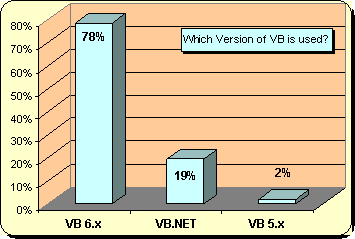
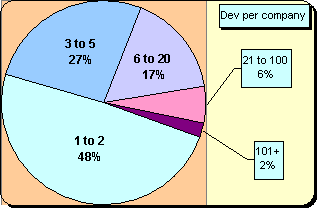
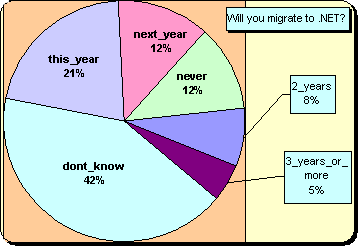 4) What do you
think is the main benefit of moving to .NET?
4) What do you
think is the main benefit of moving to .NET?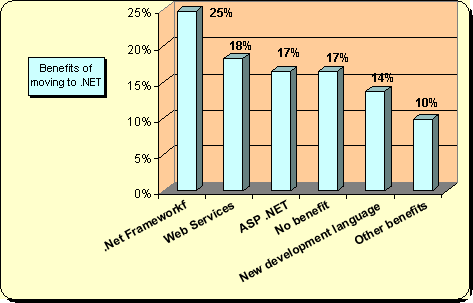 5) If you currently
develop with .NET or plan to do so later, what kinds of projects
will you work on?
5) If you currently
develop with .NET or plan to do so later, what kinds of projects
will you work on?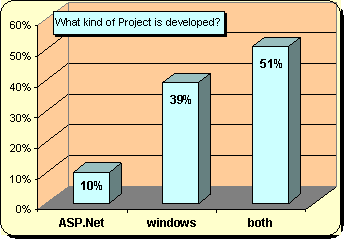 6) Which other
technologies are (or will be) used in your company?
6) Which other
technologies are (or will be) used in your company?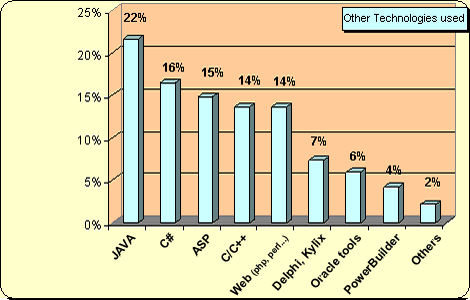 7)
As a developer, what is your opinion of VB?
7)
As a developer, what is your opinion of VB? 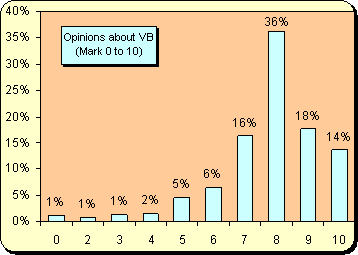 8)
What is your opinion of the VB support provided by Microsoft?
8)
What is your opinion of the VB support provided by Microsoft? 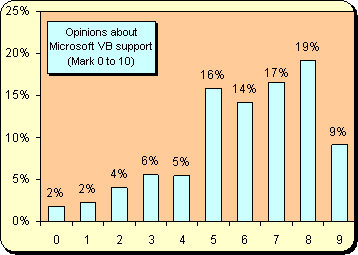 9)
What is the average size of your VB projects?
9)
What is the average size of your VB projects?